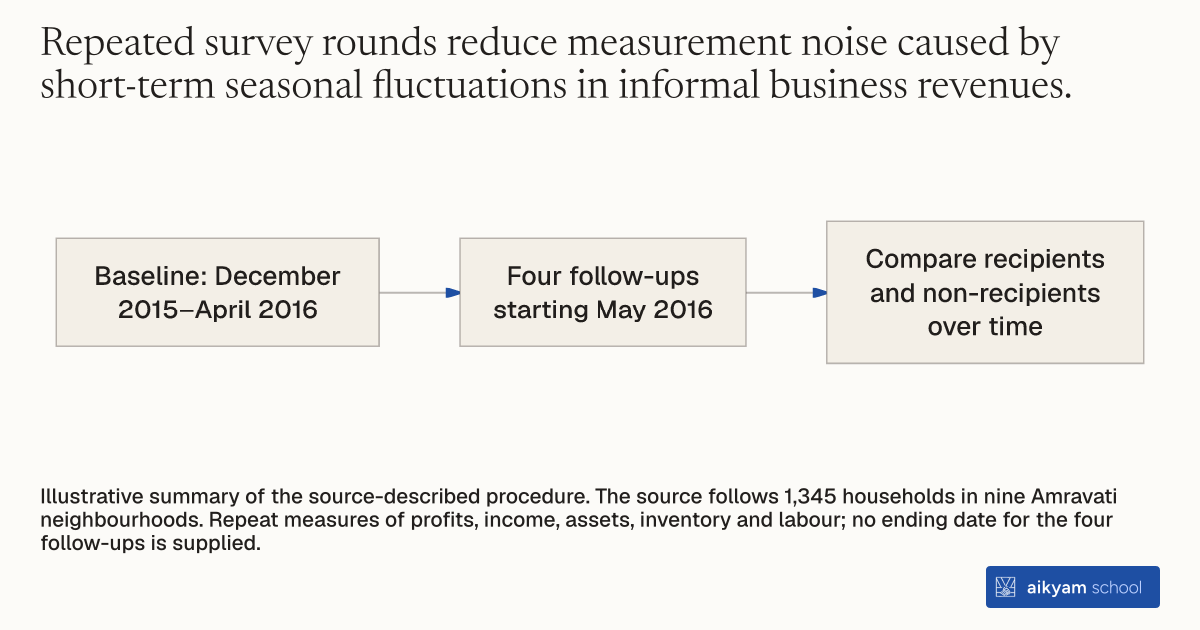
Research steps
Track enterprises across survey rounds
- Baseline: December 2015–April 2016
- Four follow-ups starting May 2016
- Compare recipients and non-recipients over time
Illustrative summary of the source-described procedure. The source follows 1,345 households in nine Amravati neighbourhoods. Repeat measures of profits, income, assets, inventory and labour; no ending date for the four follow-ups is supplied.
See source →How
When to use
Researchers and evaluation teams need to measure changes in business profits, labor inputs, and household income following financial grants or loans. Single cross-sectional surveys fail to capture fluctuating profits and operational adjustments over time in informal microenterprises. Administering a baseline survey followed by multiple longitudinal follow-up rounds tracks dynamic enterprise impacts over time.
Track microentrepreneur performance by conducting a baseline survey followed by four longitudinal follow-up survey rounds.
- Administer a baseline survey to all participating households between December 2015 and April 2016.
- Record baseline metrics on business profits, household income, enterprise asset holdings, labor supply, and personal expenditures.
- Conduct four sequential follow-up survey rounds with all participating microentrepreneurs starting in May 2016.
- Collect recurring enterprise metrics during each follow-up round to observe changes in weekly labor hours, monthly working days, inventory purchases, and monthly profits.
- Aggregate longitudinal survey rounds across grant recipients and non-recipients to calculate treatment impacts over time.
Why it works
Longitudinal tracking allows evaluation teams to observe whether capital investments produce sustained profit growth and structural changes in labor allocation.
Example
Researchers tracked 1,345 microentrepreneurs across nine peri-urban neighborhoods in Amravati, Maharashtra, India. They conducted baseline surveys from December 2015 to April 2016 and completed four follow-up survey rounds starting in May 2016 to measure monthly household profits, inventory accumulation, and labor hours after distributing 100 US dollar cash grants.
About the study
Participants
1,345 households across nine peri-urban neighborhoods in Amravati, Maharashtra, India.
Study Design
Longitudinal panel evaluation administering baseline surveys between December 2015 and April 2016 and four follow-up surveys starting in May 2016 across cash grant recipients and non-recipients.
Results
Longitudinal tracking revealed that grant winning households earned an extra 567 Indian rupees in monthly household income and 683 Indian rupees in monthly profits, while top-ranked entrepreneurs worked an additional 9.9 hours per week and 4.6 days per month.