Research steps
Track household sanitation choices
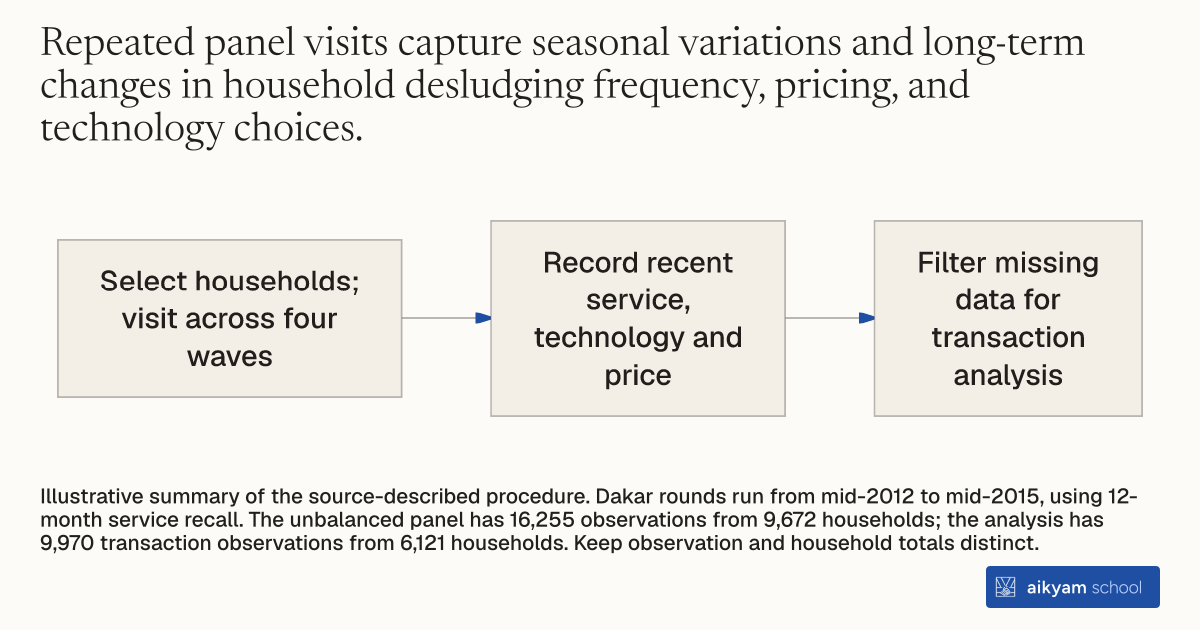
- Select households; visit across four waves
- Record recent service, technology and price
- Filter missing data for transaction analysis
Illustrative summary of the source-described procedure. Dakar rounds run from mid-2012 to mid-2015, using 12-month service recall. The unbalanced panel has 16,255 observations from 9,672 households; the analysis has 9,970 transaction observations from 6,121 households. Keep observation and household totals distinct.
See source →How
When to use
Researchers need to track household technology choices, transaction prices, and demand responsiveness across urban residential areas over time. The method addresses recall errors and missing longitudinal data when assessing consumer demand for sanitation and decentralized utility services. It is designed for study teams evaluating public health impacts, price elasticity, and service adoption across peri-urban settlements.
Track longitudinal sanitation decisions and transaction costs by administering four survey waves to a panel of urban households.
- Survey teams select residential households across designated arrondissements using map grid overlays and spatial sampling.
- Enumerators visit selected households across four distinct survey rounds between mid-2012 and mid-2015.
- Enumerators record whether each household received a desludging over the prior 12 months.
- Enumerators log the chosen technology option among manual family labor, hired manual labor, or mechanized vacuum truck.
- Enumerators record the reported transaction price paid for the most recent service along with search methods and household characteristics.
- Survey analysts filter out households without recent desludgings or missing key variables to build a panel dataset for econometric modeling.
Why it works
Direct reported transaction prices overcome the lack of posted price lists in informal, bilaterally negotiated utility markets.
Example
Researchers in Dakar, Senegal administered four rounds of a household panel survey across seven residential arrondissements between mid-2012 and mid-2015. The team collected an unbalanced panel of 16,255 survey observations from 9,672 households, which yielded a final analytical sample of 9,970 transaction observations from 6,121 unique households.
About the study
Participants
16,255 survey observations from 9,672 households across seven residential arrondissements in Dakar, Senegal, resulting in a final sample of 9,970 transaction observations from 6,121 unique households.
Study Design
Four-round longitudinal household panel survey tracking desludging technology selection (mechanized, manual baay pell, or family) and reported transaction prices over 12-month recall periods.
Results
Mechanized desludging had a 50% market share at an average cost of 22,800 CFA (\$46) per trip, manual baay pell labor captured 24% at 14,300 CFA (\$24-\$32), family manual labor captured 26% at 530 CFA, and 56% of mechanized transactions clustered at round focal prices of 20,000, 25,000, or 30,000 CFA.