Research procedure
Follow clients across three surveys
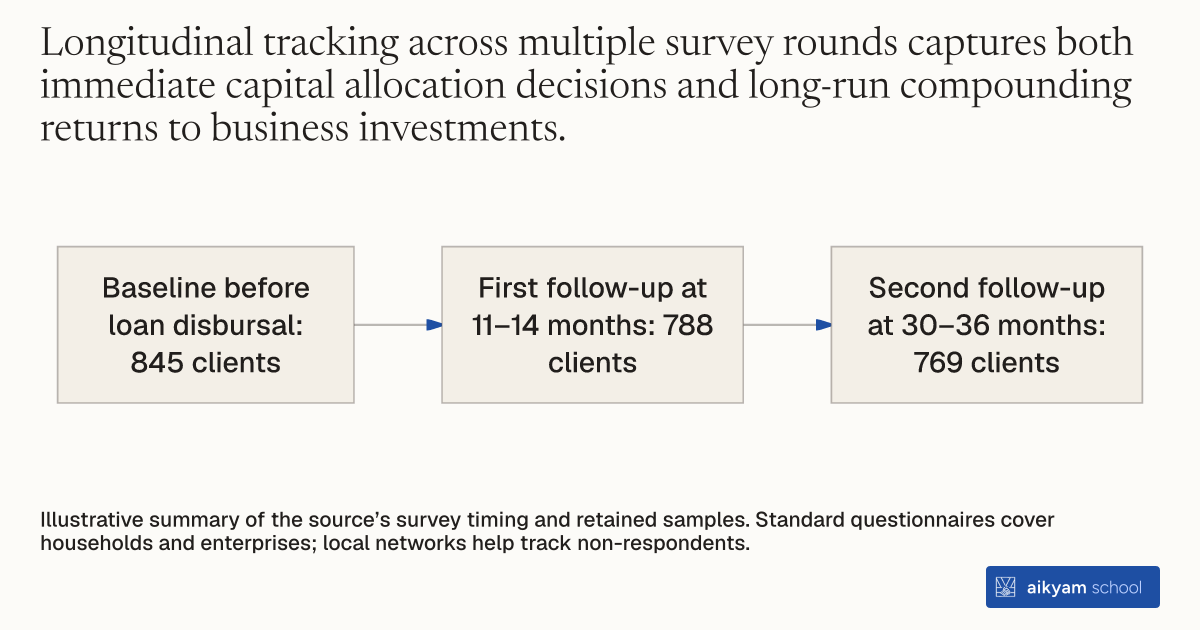
- Baseline before loan disbursal: 845 clients
- First follow-up at 11–14 months: 788 clients
- Second follow-up at 30–36 months: 769 clients
Illustrative summary of the source’s survey timing and retained samples. Standard questionnaires cover households and enterprises; local networks help track non-respondents.
See source →How
When to use
Low-income microfinance clients operate small informal enterprises with highly variable monthly income and expenditures. Lenders and impact evaluators need reliable long-term data to measure how debt contracts affect business investment, household welfare, and loan outcomes over time. Administering multi-wave panel surveys across several years tracks persistent economic changes while minimizing survey attrition.
Administer a three-wave longitudinal survey tracking microfinance clients and household enterprises across a three-year evaluation window.
- Conduct a comprehensive baseline survey prior to loan disbursal to gather client demographic, household, and initial business data.
- Administer a first follow-up survey eleven to fourteen months after loan disbursal to evaluate short-term business investments.
- Administer a second follow-up survey thirty to thirty-six months post-disbursal to capture long-run business capital, profits, and household income.
- Track survey non-respondents through local community networks to maintain high sample retention rates across survey rounds.
- Survey clients in their homes or enterprise locations using standardized questionnaires covering business profits, assets, and expenditures.
Why it works
Collecting baseline measurements enables precise difference-in-differences analysis while controlling for pre-existing household characteristics.
Example
Survey enumerators conducted three survey waves with 845 female microfinance clients in Kolkata, India between October 2006 and December 2009. The team re-surveyed 788 clients in wave two and 769 clients in wave three, maintaining a 91.0 percent longitudinal retention rate over nearly three years.
About the study
Participants
845 low-income female microfinance clients surveyed at baseline in Kolkata, India, with 769 clients surveyed at 3-year endline.
Study Design
Three-wave longitudinal panel study measuring microenterprise and household welfare outcomes 1 year and 3 years post-disbursal across randomized loan contract groups.
Results
The multi-wave survey maintained a 93.3 percent retention rate in wave two and a 91.0 percent retention rate in wave three, revealing that grace period clients achieved 41.0 percent higher weekly profits (2,238.4 rupees vs 1,586.8 rupees) and 19.5 percent higher household income nearly three years after loan disbursal.