Research steps
Track job search by phone
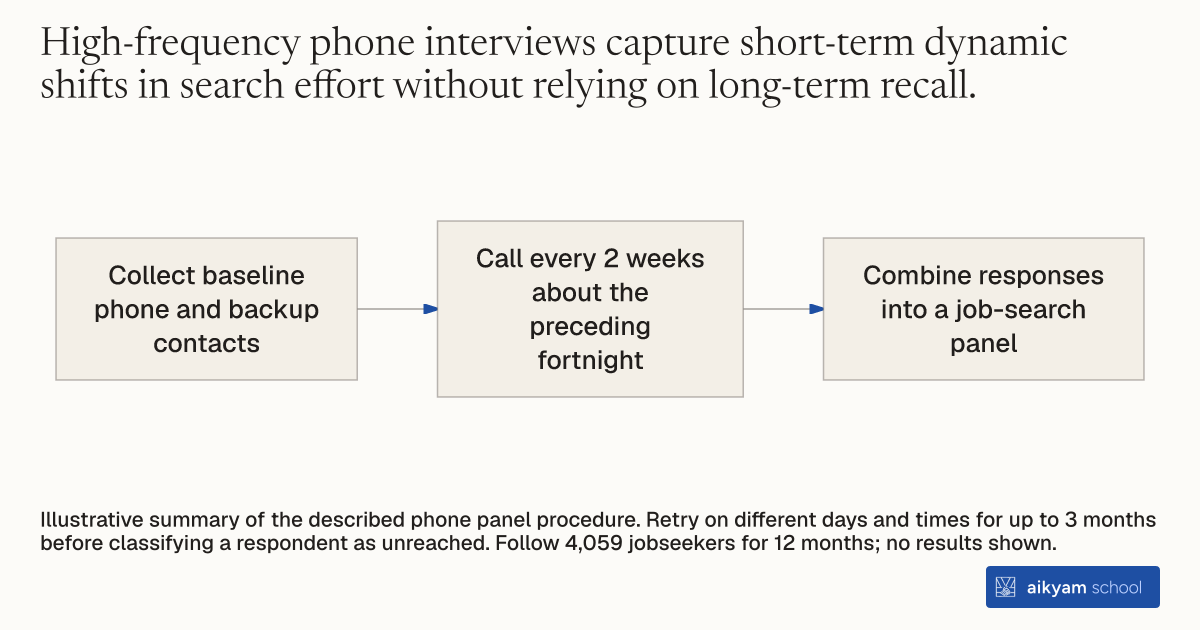
- Collect baseline phone and backup contacts
- Call every 2 weeks about the preceding fortnight
- Combine responses into a job-search panel
Illustrative summary of the described phone panel procedure. Retry on different days and times for up to 3 months before classifying a respondent as unreached. Follow 4,059 jobseekers for 12 months; no results shown.
See source →How
When to use
Use this method when monitoring continuous behavioral changes and search effort over time in active labor market interventions. It addresses the problem of recall bias and unobserved dynamic responses in standard pre-post survey designs. It serves researchers, program evaluators, and labor analysts tracking real-time participant outcomes.
Track candidate job search trajectories over time by administering short phone questionnaires at regular biweekly intervals between baseline and endline surveys.
- Collect active cellular phone numbers and secondary contact details for all study participants during baseline face-to-face interviews.
- Design a brief structured phone questionnaire focusing on fortnightly job board visits, job applications, interview invitations, and job offers.
- Call participants by phone every two weeks across the entire study period to record search activities for the preceding fortnight.
- Make repeated call attempts across different days and times for up to three months before classifying a respondent as unreached.
- Aggregate biweekly call data into a panel dataset to plot search intensity trajectories and estimate high-frequency treatment effects.
Why it works
Regular phone calls maintain participant contact, keeping attrition low over extended experimental follow-up periods.
Example
Researchers in Addis Ababa, Ethiopia conducted biweekly phone surveys with 4,059 young jobseekers over a one-year experimental period. The phone panel revealed that job board visits among treated jobseekers increased by 8.3 percentage points within six weeks of the first job fair while maintaining a 90% response rate in the final month.
About the study
Participants
N = 4,059 young jobseekers aged 18 to 29 in Addis Ababa, Ethiopia.
Study Design
Longitudinal high-frequency panel phone survey administered biweekly over a 12-month period following a randomized job fair experiment.
Results
Maintained a 90% phone contact rate in the final study month and detected an 8.3 percentage point increase in job board visits six weeks post-treatment.