Research groups
Allocate villages within sampled districts
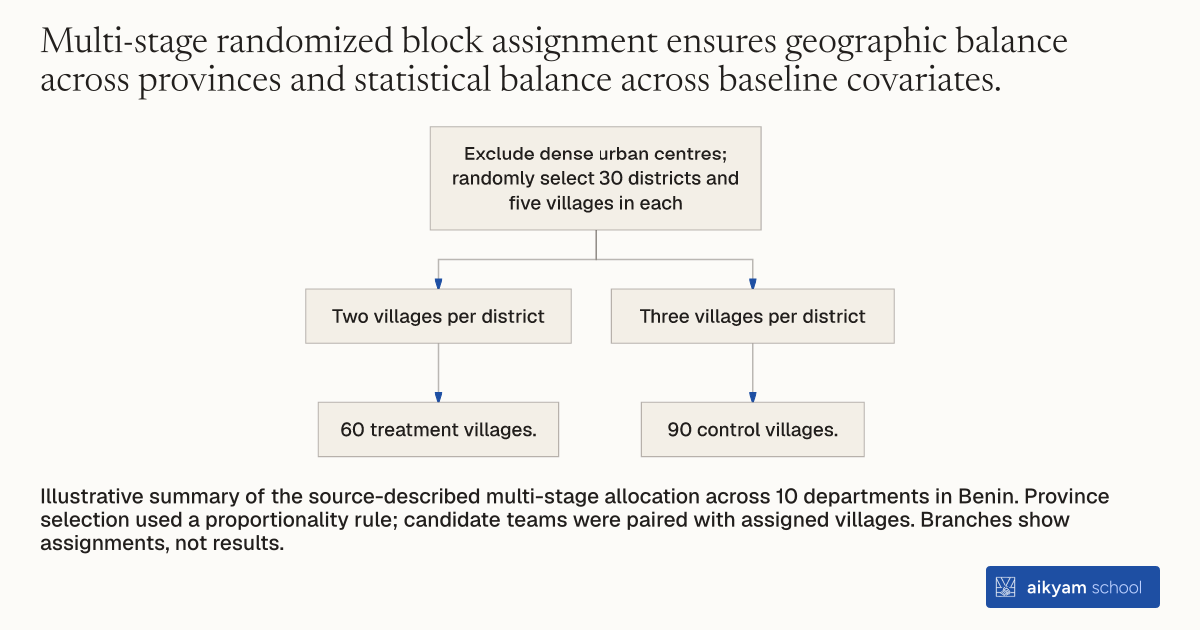
Exclude dense urban centres; randomly select 30 districts and five villages in each
- Two villages per district
- 60 treatment villages.
- Three villages per district
- 90 control villages.
Illustrative summary of the source-described multi-stage allocation across 10 departments in Benin. Province selection used a proportionality rule; candidate teams were paired with assigned villages. Branches show assignments, not results.
See source →How
When to use
When designing a political field experiment or community intervention across a national or multi-district setting, simple random sampling risks geographic imbalance or cross-treatment contamination. Use multi-stage randomized block sampling to systematically select administrative districts, sample representative sub-units, and assign them to treatment and control conditions while mitigating spillovers.
Implement a multi-stage randomized block sampling and allocation protocol to select electoral districts and assign villages to experimental conditions.
- Exclude high-density urban centers to minimize contamination between treatment and control units.
- Determine the number of districts to select per province using a proportionality rule based on district counts.
- Select 30 electoral districts across eligible provinces using a random number generator.
- Select 5 villages in each chosen district using a random number generator to reach 150 villages nationwide.
- Assign 2 villages per district to the treatment group and 3 villages to the control group.
- Pair participating presidential candidate teams with the assigned treatment and control villages in each district.
Why it works
Setting a fixed ratio of treatment and control villages within each district controls for district-level unobserved factors while preserving statistical power.
Example
In Benin during the March 2011 presidential election, researchers used randomized block sampling to select 30 districts across 10 departments and assigned 150 villages, placing 60 villages in the treatment group and 90 in the control group. A representative sample of 30 households per village was then selected for surveying.
About the study
Participants
150 villages across 30 electoral districts in 10 departments of Benin, with 30 households surveyed per village (5,009 total survey respondents).
Study Design
Multi-stage randomized block design with 60 villages assigned to treatment (2 per district) and 90 to control (3 per district), verified through balance tests on demographic, political, and economic baseline variables.
Results
Covariate balance tests confirmed no significant differences between treatment and control baseline means for gender (0.61 vs 0.59), age (36.97 vs 37.08), or steady income (1.78 vs 1.77), with minor differences in education (0.49 vs 0.46) and expected turnout (1.05 vs 1.08).