Research procedure
Match sites, then sample adults
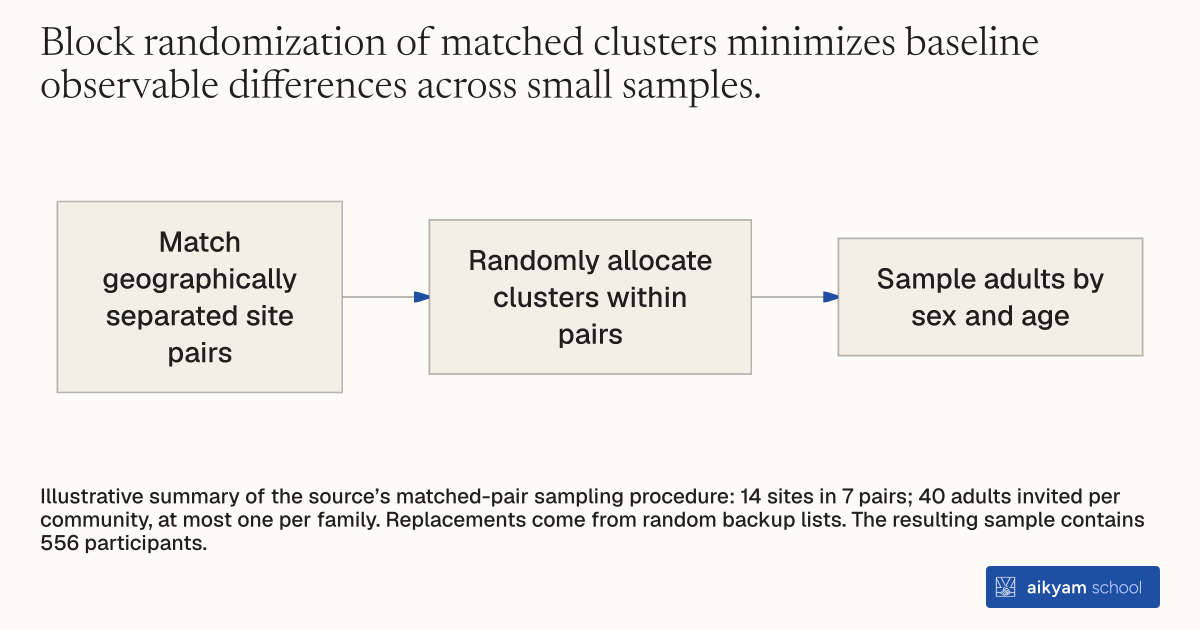
- Match geographically separated site pairs
- Randomly allocate clusters within pairs
- Sample adults by sex and age
Illustrative summary of the source’s matched-pair sampling procedure: 14 sites in 7 pairs; 40 adults invited per community, at most one per family. Replacements come from random backup lists. The resulting sample contains 556 participants.
See source →How
When to use
Researching sensitive political behaviors or social norms across diverse community types requires balanced sampling without baseline differences. When evaluating cluster-level interventions across varied subpopulations, researchers need to ensure treatment and comparison groups share similar demographic, regional, and socioeconomic backgrounds. Matched pair stratified sampling controls observable variance in small cluster samples while maintaining representativeness.
Select research sites matching key demographic and geographic characteristics, then randomly sample stratified community members into group listening units.
- Select paired sites representing salient ethnic and institutional categories, matching general population villages within regions using census data on dwelling quality, education, religion, and gender ratio.
- Ensure paired communities are geographically separated enough to avoid market sharing and prevent information spillover.
- Randomly assign one cluster in each matched pair to the treatment condition and the other to the comparison condition.
- Obtain official population lists for each community cluster and stratify the population by sex and age groups.
- Draw a random sample of 40 adults per community inviting at most one person per family, drawing replacements from a randomized backup list when needed.
Why it works
Individual stratification ensures representative demographic coverage across gender and age cohorts.
Example
In post-genocide Rwanda, researchers selected 14 research sites arranged into seven matched pairs representing genocide survivors, Twa minorities, prisons, and general population regions. From census and official lists, they randomly sampled 40 adults per cluster stratified by age and sex, yielding a total sample of 556 participants across the 14 sites.
About the study
Participants
556 participants across 14 community clusters in Rwanda (50% male, average age 38.9 years, 79% farmers), comprising 2 survivor communities, 2 Twa communities, 2 prisons, and 8 general population sites across 4 regions.
Study Design
Matched pair cluster-randomized design where 14 clusters were matched into 7 pairs based on census covariates (dwelling quality, religion, education, gender ratio) and randomly assigned to treatment or control, sampling 40 individuals per site stratified by age and gender.
Results
Randomization successfully balanced baseline characteristics across treatment and comparison groups, confirmed by a non-significant F-test regressing treatment assignment on background attributes (F = 0.73, p = 0.65).