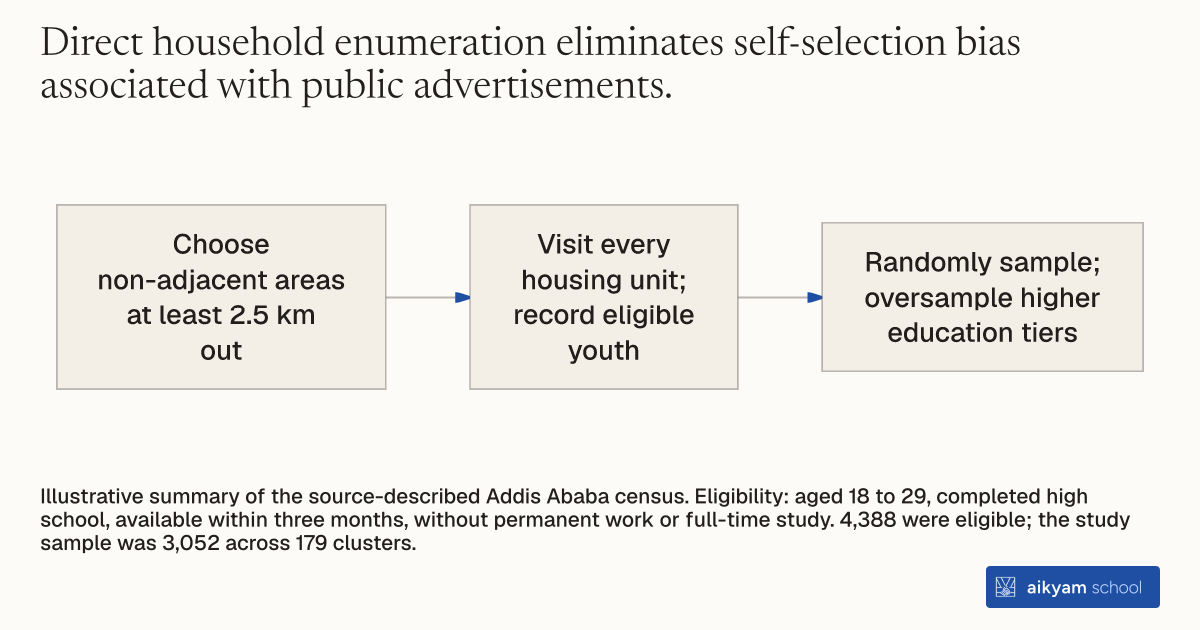
Research steps
Build a household sampling list
- Choose non-adjacent areas at least 2.5 km out
- Visit every housing unit; record eligible youth
- Randomly sample; oversample higher education tiers
Illustrative summary of the source-described Addis Ababa census. Eligibility: aged 18 to 29, completed high school, available within three months, without permanent work or full-time study. 4,388 were eligible; the study sample was 3,052 across 179 clusters.
See source →How
When to use
Researchers need a representative sample of eligible youth for labor market studies. Random phone dialing or central registries miss off-grid or informal job-seekers. Enumerate households directly in selected geographic clusters to build a clean baseline sampling frame.
Conduct door-to-door household censuses across selected urban clusters to identify eligible individuals for target programs.
- Select non-adjacent geographic enumeration areas located outside the city center to avoid local spillover effects.
- Visit every housing unit in selected areas to list all residents meeting age and education criteria.
- Verify that candidates are available for work and currently lack permanent jobs or full-time study commitments.
- Record demographic details, contact numbers, and education levels for all eligible individuals.
- Randomly select candidates from the census list, oversampling higher education tiers to ensure balanced representation across subgroups.
Why it works
Sampling within defined geographic boundaries ensures a population-representative panel for measuring local labor interventions.
Example
Researchers screened urban youth across 179 enumeration areas in Addis Ababa, Ethiopia. Enumerators identified 4,388 eligible individuals aged 18 to 29 who completed high school and lacked permanent work.
About the study
Participants
N = 4,388 eligible youth aged 18–29 in Addis Ababa, Ethiopia, resulting in a randomized study sample of 3,052 individuals across 179 clusters.
Study Design
Door-to-door enumeration across Central Statistical Agency enumeration areas located at least 2.5 km from the city center, oversampling post-secondary degree holders.
Results
Identified an eligible population representing approximately 20% of all urban youth, constructing a representative baseline sample with balanced socio-demographic coverage.