Try, learn and adjust
Check follow-up payments match tree survival
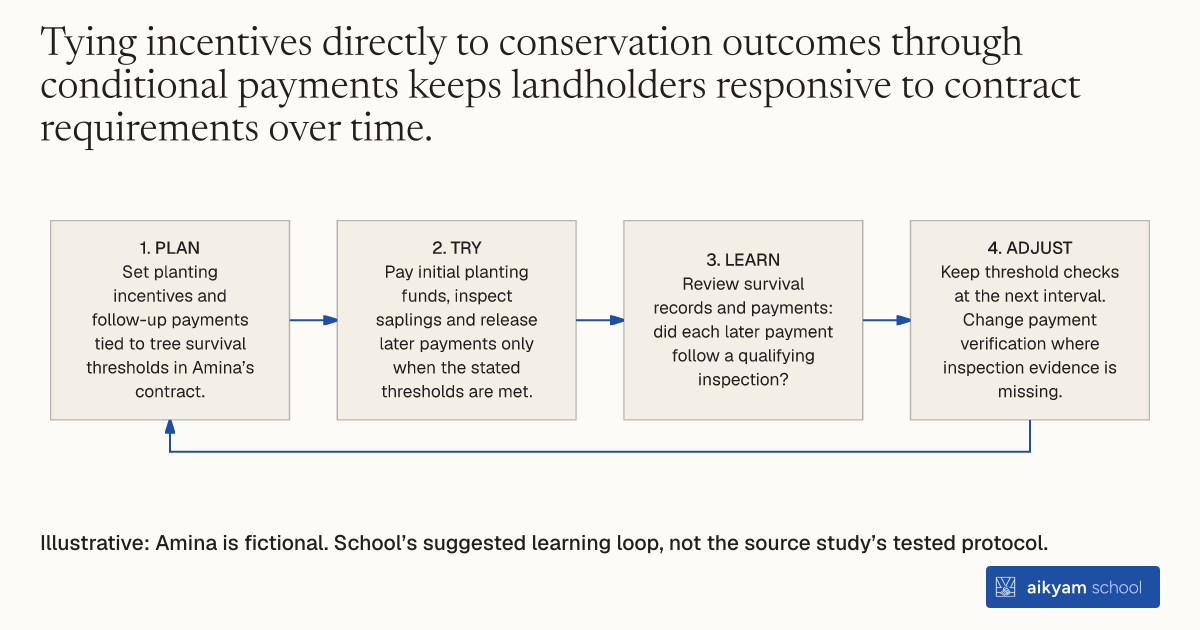
- Plan: Set planting incentives and follow-up payments tied to tree survival thresholds in Amina’s contract.
- Try: Pay initial planting funds, inspect saplings and release later payments only when the stated thresholds are met.
- Learn: Review survival records and payments: did each later payment follow a qualifying inspection?
- Adjust: Keep threshold checks at the next interval. Change payment verification where inspection evidence is missing.
Illustrative: Amina is fictional. School’s suggested learning loop, not the source study’s tested protocol.
See source →School’s suggested, untested loop. Observe planting, survival and payment conditions. No numerical threshold or inspection interval is supplied here.
How
When to use
One-time or upfront payment incentives fail to motivate landholders to maintain planted trees over time. Landholders frequently abandon saplings after receiving initial payments, leading to low tree survival rates. Adding conditional follow-up payments tied to tree survival thresholds solves long-term maintenance issues for afforestation program managers.
Offer landholders follow-up payments that are conditioned on reaching specified tree planting and survival thresholds.
- Design afforestation contracts that split payments into initial planting incentives and conditional follow-up installments.
- Disburse initial funds to participating landholders to cover tree planting expenses.
- Establish minimum survival rate thresholds for planted trees that landholders must meet at designated follow-up intervals.
- Conduct field inspections to measure sapling survival rates against contract thresholds.
- Release follow-up payment installments only to landholders who meet or exceed the required survival thresholds.
Why it works
This ongoing financial incentive ensures landholders continue watering and protecting saplings through critical growth stages.
Example
Researchers tested payment structures for a tree planting program in Zambia, finding that adding follow-up payments after reaching a threshold of tree planting and survival was more effective at sustaining tree growth than offering only one-time or upfront incentives.
About the study
Participants
Human landholders participating in a tree planting and afforestation program in Zambia.
Study Design
Randomized Controlled Trial comparing one-time or upfront incentive payments against multi-stage follow-up payments tied to tree planting and survival thresholds.
Results
Adding follow-up payments after reaching a threshold of tree planting and survival sustained tree growth more effectively than offering only one-time or upfront incentives.