Research procedure
Follow graduates across three survey rounds
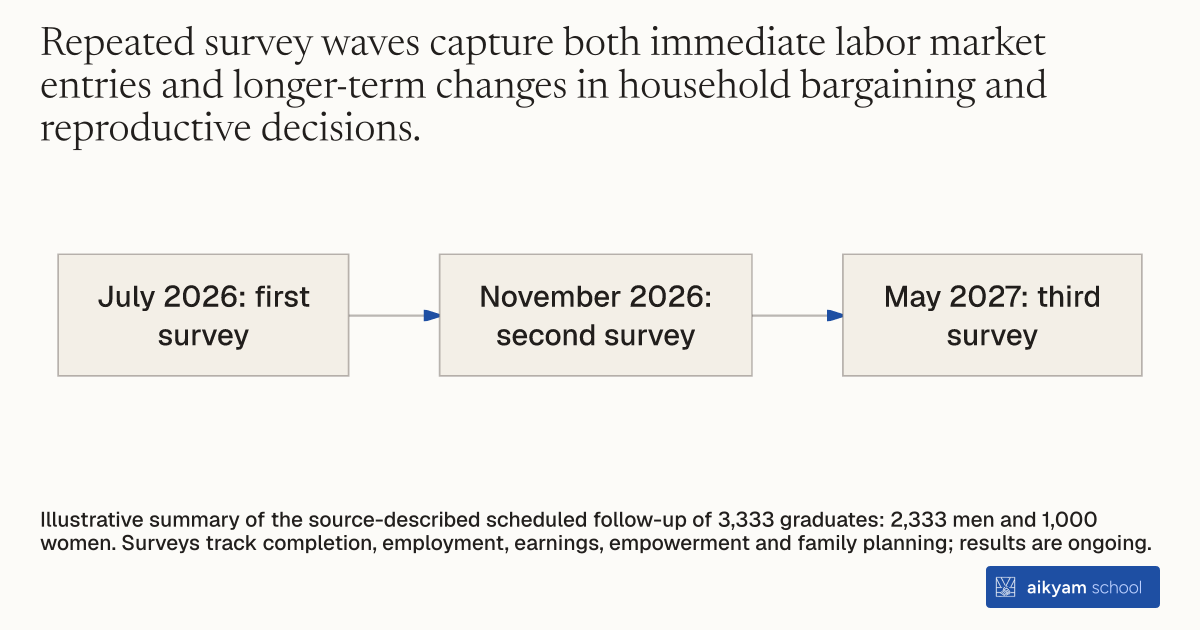
- July 2026: first survey
- November 2026: second survey
- May 2027: third survey
Illustrative summary of the source-described scheduled follow-up of 3,333 graduates: 2,333 men and 1,000 women. Surveys track completion, employment, earnings, empowerment and family planning; results are ongoing.
See source →How
When to use
Evaluating job training programs over time requires tracking participant outcomes across multiple post-treatment periods. Cross-sectional surveys fail to capture dynamic shifts in income, empowerment, and family planning choices over time. Conduct multi-wave panel surveys to systematically record employment trajectories and personal decision-making outcomes across participants.
Administer three sequential rounds of panel surveys across participants to evaluate employment, earnings, and family planning outcomes over time.
- Deploy survey team members from J-PAL South Asia to track the 3,333 trial participants across urban Delhi and Maharashtra.
- Conduct the first survey round in July 2026 following the completion of cohort training rollouts.
- Administer the second survey round in November 2026 to capture mid-term changes in employment status and income.
- Execute the third survey round in May 2027 to measure long-term trajectory shifts and sustained impact.
- Collect data on program completion, STEM employment, earnings, bank account ownership, intra-household decision-making, marital status, gender-based violence, and contraceptive practices across survey waves.
Why it works
Longitudinal data collection allows researchers to evaluate whether initial economic gains lead to sustained personal empowerment and demographic shifts.
Example
J-PAL South Asia scheduled three survey rounds in July 2026, November 2026, and May 2027 to track 3,333 graduates across urban Delhi and Maharashtra.
About the study
Participants
3,333 college graduates (2,333 men and 1,000 women) with engineering or computer science degrees in urban Delhi and Maharashtra, India.
Study Design
Randomized controlled trial collecting three rounds of panel survey data (July 2026, November 2026, and May 2027) to evaluate labor market, empowerment, and health outcomes.
Results
Research is ongoing with survey collection measuring earnings, STEM employment, intra-household decision-making, and contraceptive use across three rounds.