Research overview
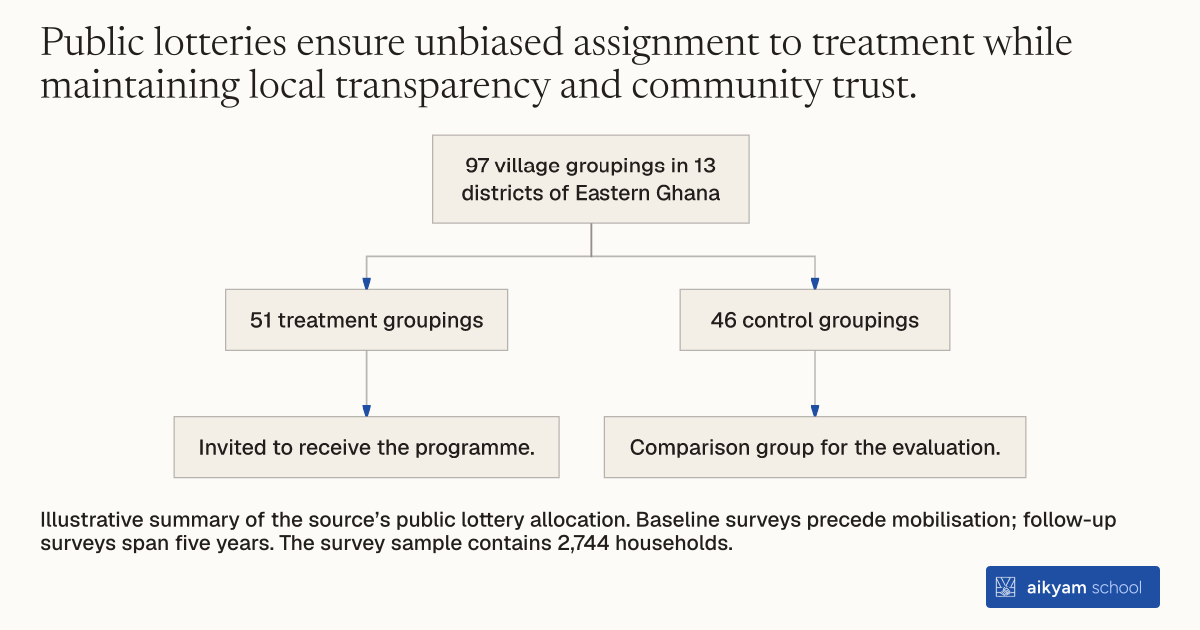
Assign village groups by public lottery
97 village groupings in 13 districts of Eastern Ghana
- 51 treatment groupings
- Invited to receive the programme.
- 46 control groupings
- Comparison group for the evaluation.
Illustrative summary of the source’s public lottery allocation. Baseline surveys precede mobilisation; follow-up surveys span five years. The survey sample contains 2,744 households.
See source →How
When to use
Rural development programs often lack rigorous evidence regarding their true socio-economic and political impacts on communities. Public lottery cluster randomization evaluation uses transparent public draws to randomly assign community clusters to treatment or control status. The method serves researchers, donors, and policymakers seeking unbiased impact estimates of community-based development programs.
Conduct a cluster-randomized evaluation using public lotteries to assign community clusters to treatment or control status.
- Define geographically distinct village groupings of approximately 10,000 people across eligible rural districts.
- Hold a public lottery in each district by pulling names out of a hat to assign village groupings to treatment or control status.
- Conduct baseline household and community leader surveys across sampled villages prior to program mobilization.
- Administer follow-up household, leader, and candidate surveys multiple years after implementation.
- Estimate intent-to-treat and treatment-on-the-treated effects using regression analysis with district fixed effects.
Why it works
Multi-year data collection across households, leaders, and political candidates isolates systemic impacts from temporary fluctuations.
Example
Researchers evaluated The Hunger Project across 97 village groupings in 13 districts of Eastern Ghana by holding public lotteries that assigned 51 groupings to treatment and 46 to control, surveying 2,744 households across five years.
About the study
Participants
2,744 households across 97 village groupings in 13 districts of Eastern Ghana.
Study Design
Five-year randomized evaluation using public lotteries for cluster assignment, evaluating OLS intent-to-treat and 2SLS instrumental variable regressions with district fixed effects.
Results
Evaluated outcomes showed a 0.211 standard deviation increase in village leadership quality and 0.556 standard deviation increase in credit access, but non-epicenter public goods contributions fell by 10 GHC and overall socio-economic indices showed no statistically significant improvement.