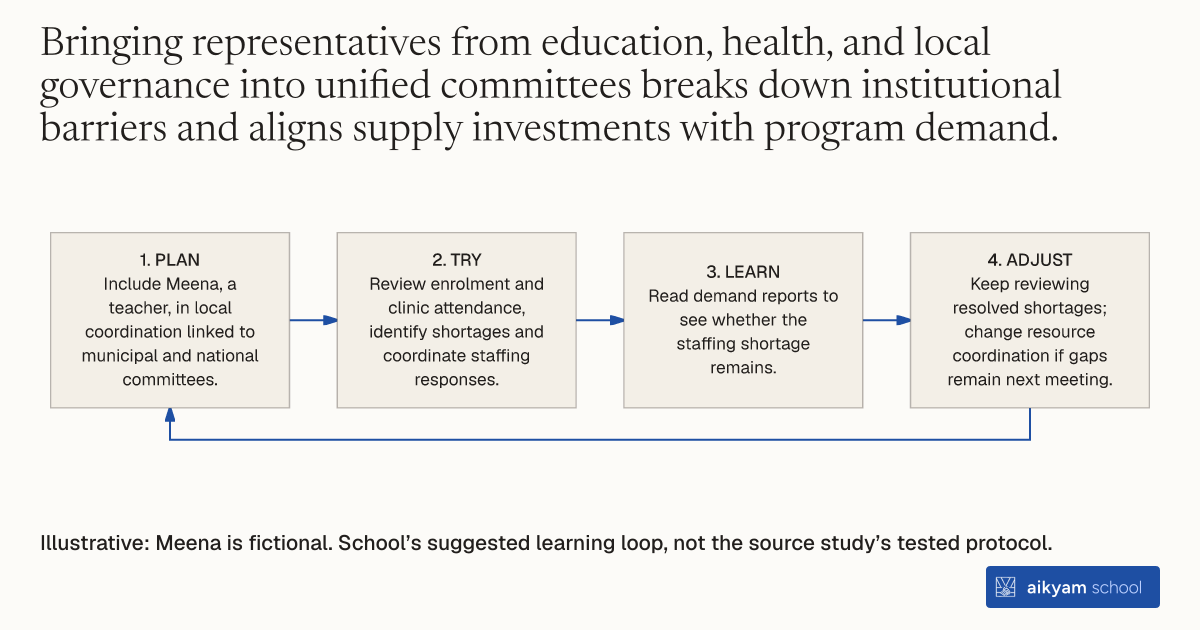
Try, learn and adjust
Check committees respond to local supply shortages
- Plan: Include Meena, a teacher, in local coordination linked to municipal and national committees.
- Try: Review enrolment and clinic attendance, identify shortages and coordinate staffing responses.
- Learn: Read demand reports to see whether the staffing shortage remains.
- Adjust: Keep reviewing resolved shortages; change resource coordination if gaps remain next meeting.
Illustrative: Meena is fictional. School’s suggested learning loop, not the source study’s tested protocol.
See source →School and clinic demand, staffing shortages and personnel allocations. School’s suggested learning loop, not a source-tested cycle.
How
When to use
Central social protection administrators face supply bottlenecks across education and health sectors when expanding cash transfer programs. Sectoral ministries often operate in silos, failing to deploy teachers or health staff where demand spikes. Inter-institutional coordination committees align government agencies at national, municipal, and local levels to solve localized supply shortages.
Establish and manage multi-sectoral coordination committees across national, municipal, and local levels to align sector ministries and resolve supply bottlenecks.
- Central program administrators convene representatives from national ministries of health, education, and social welfare to form a national coordination committee.
- Program administrators establish municipal coordination committees in each target district comprising local mayors, school directors, and health officers.
- Program administrators form local community committees with local leaders, teachers, and health personnel.
- Municipal committees meet periodically to review program demand data, school enrollment figures, and healthcare clinic attendance reports.
- Committee representatives identify local supply shortages, such as overcrowded classrooms or unstaffed health posts.
- Education and health ministry representatives reallocate government personnel, such as assigning additional government teachers to high-demand primary schools.
Why it works
This coordination enables rapid administrative responses to localized infrastructure and staffing bottlenecks without requiring costly new construction projects.
Example
In rural Nicaragua, the central administration of the Red de Protección Social established multi-sectoral committees at national, municipal, and local levels. This inter-institutional coordination enabled local school authorities to address surging primary school enrollment by directing ad hoc placements of additional government teachers to bottlenecked rural schools across the 42 program comarcas.
About the study
Participants
Target primary schools and communities across 42 rural comarcas in six municipalities in central and northern Nicaragua.
Study Design
Process evaluation of multi-level inter-institutional coordination committees supporting a randomized clustered conditional cash transfer intervention.
Results
Inter-institutional coordination effectively redirected government administrative resources, facilitating ad hoc placements of additional government teachers to meet increased primary school enrollment without requiring dedicated school construction funds.