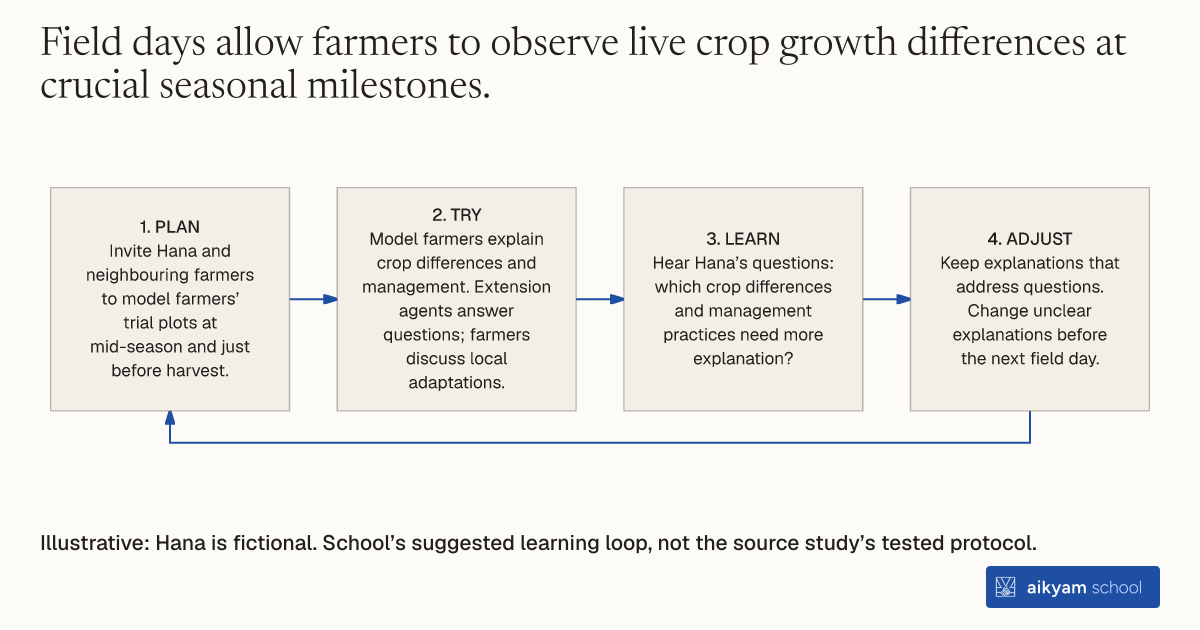
Try, learn and adjust
Check questions raised at farmer field days
- Plan: Invite Hana and neighbouring farmers to model farmers’ trial plots at mid-season and just before harvest.
- Try: Model farmers explain crop differences and management. Extension agents answer questions; farmers discuss local adaptations.
- Learn: Hear Hana’s questions: which crop differences and management practices need more explanation?
- Adjust: Keep explanations that address questions. Change unclear explanations before the next field day.
Illustrative: Hana is fictional. School’s suggested learning loop, not the source study’s tested protocol.
See source →School’s suggested, untested loop. Observe crop comparisons and questions discussed; this does not establish adoption effects.
How
When to use
Farmer research group members need practical opportunities to evaluate demonstration plots during the growing cycle. Static classroom instruction lacks real-time observational learning during crucial crop development phases. Hosting organized field days enables smallholders to observe crop performance and discuss technical practices directly with lead farmers.
Host community-level farmer field days to demonstrate comparative trial plot progress during critical crop growth stages.
- Schedule two farmer field day events per harvest cycle within each microwatershed during mid-season growth and immediately before harvest.
- Convene group members and interested neighboring farmers at local on-farm demonstration plots managed by model farmers.
- Direct model farmers to share their personal experience, technical management steps, and observed crop differences between side-by-side trial plots.
- Station public extension agents at field sites to complement model farmer explanations and answer technical questions.
- Facilitate structured discussions among attending farmers to encourage peer-to-peer knowledge sharing and local adaptation of techniques.
Why it works
Direct peer interaction with model farmers and extension agents addresses specific management doubts and builds practical confidence in new technology packages.
Example
In the GIZ-ISFM+ project across Amhara, Oromia, and Tigray in Ethiopia, extension agents and model farmers conducted two field days per harvest cycle in 72 treatment microwatersheds during 2016 and 2017. Across 388 field day participants and matched controls, participating in field days under standard extension increased adopted technologies by 1.133 practices and raised full-package adoption by 23.7 percentage points compared to matched control farmers.
About the study
Participants
N = 388 field day participants and matched controls across 2,382 smallholder farming households in Ethiopia.
Study Design
Subsample econometric evaluation in a cluster RCT comparing actual field day participants against matched control farmers using propensity score matching.
Results
Assignment to extension alone (T1) increased adopted practices by 1.133 (p < 0.01) and integrated full-package adoption by 23.7 percentage points (p < 0.01) among field day attendees relative to matched control farmers.