Try, learn and adjust
Check the farmer field day
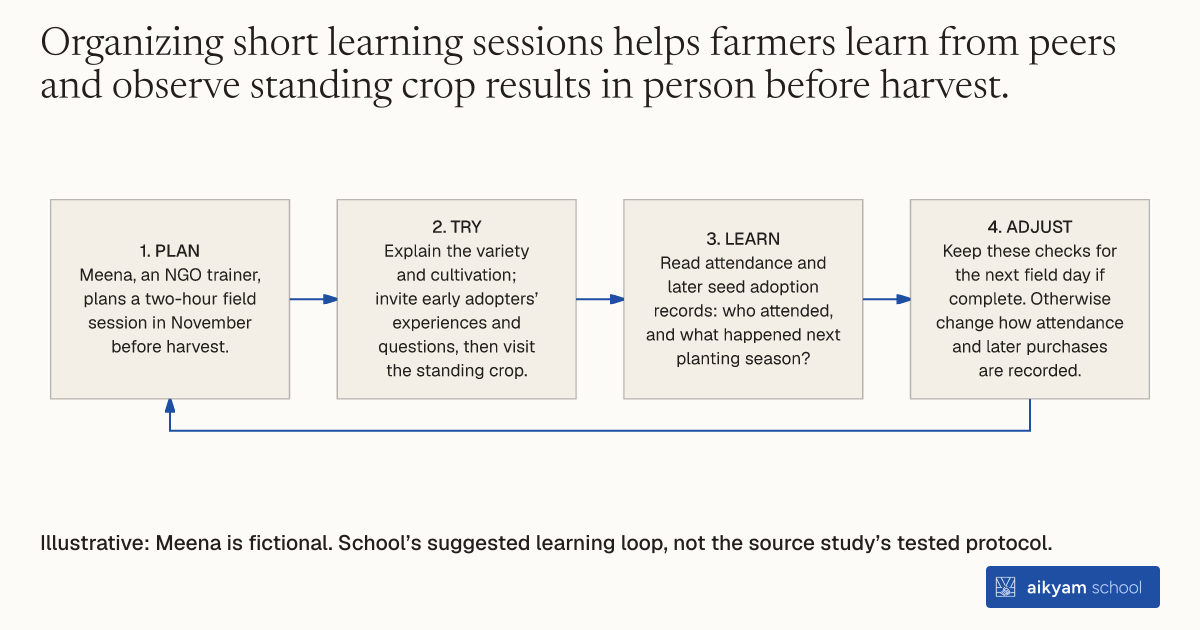
- Plan: Meena, an NGO trainer, plans a two-hour field session in November before harvest.
- Try: Explain the variety and cultivation; invite early adopters’ experiences and questions, then visit the standing crop.
- Learn: Read attendance and later seed adoption records: who attended, and what happened next planting season?
- Adjust: Keep these checks for the next field day if complete. Otherwise change how attendance and later purchases are recorded.
Illustrative: Meena is fictional. School’s suggested learning loop, not the source study’s tested protocol.
See source →School’s suggested, untested learning loop. Observe attendance and subsequent adoption; this loop does not establish the causal effect of field days.
How
When to use
Smallholder farmers in flood-prone areas often hesitate to adopt resilient crop varieties due to a lack of firsthand information about crop performance. Extension workers need a low-cost community intervention to showcase real crop results before harvest. This method hosts brief interactive meetings in early adopters' fields prior to harvest to let peers observe crop performance and ask questions.
Host two-hour interactive field sessions prior to harvest where early adopters share experiences and demonstrate new crop performance to local peers.
- NGO trainers organize a two-hour learning gathering in target villages during November prior to crop harvest.
- NGO trainers describe the specific benefits and similarities of the new crop variety compared to traditional varieties.
- NGO trainers provide practical advice on how to cultivate the new seed variety properly.
- Early adopters speak to attendees about their personal experiences using the seeds and answer peer questions.
- NGO trainers guide attendees into the field to observe the standing crop directly.
Why it works
This peer observation builds trust and provides actionable knowledge that drives subsequent seed purchases.
Example
In 50 flood-prone villages in Odisha, India, NGO staff held two-hour field days in November 2014 before the rice harvest. About 59 percent of rice-farming households attended, hearing early adopters share experiences and inspecting Swarna-Sub1 crops in the field. Attendance increased seed adoption by 41 percent in the next planting season relative to comparison villages.
About the study
Participants
100 villages (50 treatment, 50 comparison) in Odisha, India; rice farmers where two-thirds lived below the US\$2.15/day poverty line and one-third belonged to scheduled castes.
Study Design
Randomized Controlled Trial evaluating two-hour farmer field days held in 50 randomly assigned villages prior to harvest compared to 50 comparison villages.
Results
Field day attendance reached 59 percent of households, increasing seed adoption from 29.7 percent in comparison villages to 41.7 percent (a 41 percent increase), at a delivery cost of US\$200 per village compared to US\$261.00 in economic benefits.