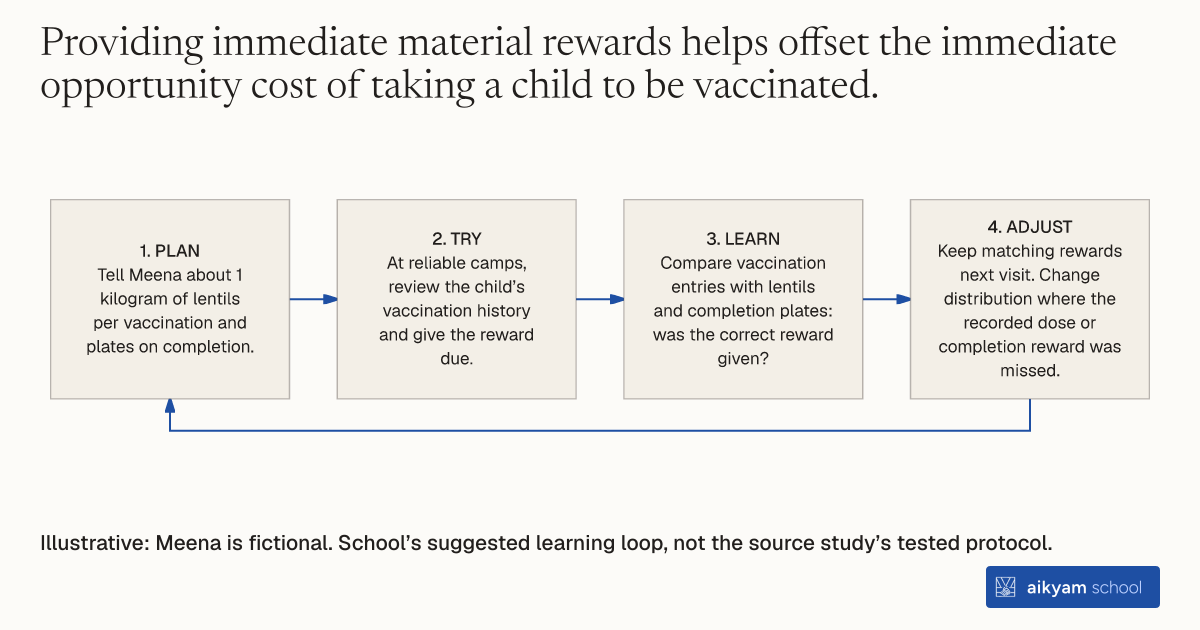
Try, learn and adjust
Check food rewards follow vaccination records
- Plan: Tell Meena about 1 kilogram of lentils per vaccination and plates on completion.
- Try: At reliable camps, review the child’s vaccination history and give the reward due.
- Learn: Compare vaccination entries with lentils and completion plates: was the correct reward given?
- Adjust: Keep matching rewards next visit. Change distribution where the recorded dose or completion reward was missed.
Illustrative: Meena is fictional. School’s suggested learning loop, not the source study’s tested protocol.
See source →School’s suggested, untested loop. Observe vaccination entries and rewards. Effects of camps plus incentives do not establish a food-only effect.
How
When to use
Parents in poor rural areas face opportunity costs and time burdens when bringing children for multi-visit vaccination schedules. Unreliable health services and present-bias lead families to delay immunizations. Offer modest non-cash food incentives at each clinic visit to offset opportunity costs and motivate completion of full childhood immunization schedules.
Distribute small non-monetary food incentives to parents at each vaccination visit and provide a higher-value bonus upon completion of the full childhood immunization course.
- Establish reliable village immunization camps using mobile health teams and local social workers.
- Give parents 1 kilogram of raw lentils for every single vaccine dose administered to their child at a camp.
- Verify prior vaccination progress using the child's official health card at each visit.
- Award a set of thalis (metal meal plates) to parents when the child receives the final dose completing the full immunization package.
- Fund the incentives using project resources, costing approximately 40 rupees (under 1 US dollar) per kilogram of lentils.
Why it works
Small non-monetary incentives overcome procrastination by making present benefits outweigh immediate costs for parents.
Example
In rural tribal villages of Udaipur district, India, NGO Seva Mandir offered 1 kilogram of lentils per vaccination and a set of thalis upon full immunization. This non-monetary incentive increased the full immunization rate among children aged 1 to 3 years to 38.3 percent compared to 16.6 percent in camp-only villages.
About the study
Participants
134 villages with almost 2,000 children under five in Udaipur District, Rajasthan, India.
Study Design
Clustered randomized controlled trial comparing mobile camps offering non-monetary incentives against camp-only villages and comparison villages.
Results
Full immunization among children aged 1 to 3 years reached 38.3 percent in incentive villages, compared to 16.6 percent in camp-only villages and 6.2 percent in comparison villages. Average cost per child completely vaccinated dropped from US\$55.83 in camp-only villages to US\$27.94 in incentive villages.