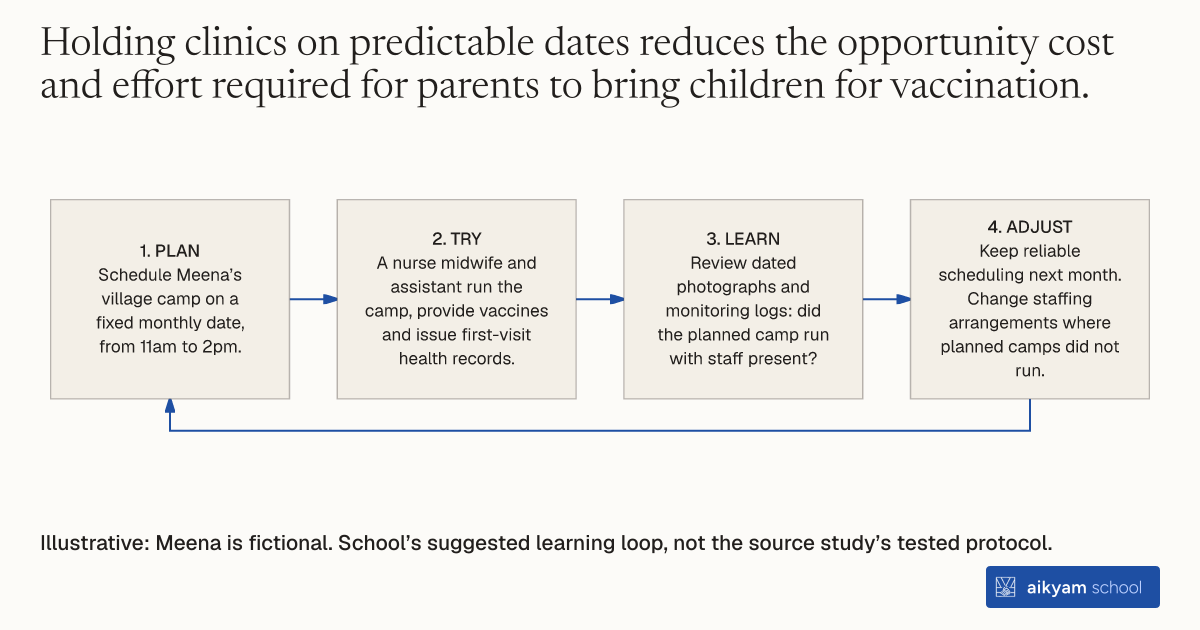
Try, learn and adjust
Check monthly camps follow the announced schedule
- Plan: Schedule Meena’s village camp on a fixed monthly date, from 11am to 2pm.
- Try: A nurse midwife and assistant run the camp, provide vaccines and issue first-visit health records.
- Learn: Review dated photographs and monitoring logs: did the planned camp run with staff present?
- Adjust: Keep reliable scheduling next month. Change staffing arrangements where planned camps did not run.
Illustrative: Meena is fictional. School’s suggested learning loop, not the source study’s tested protocol.
See source →School’s suggested, untested loop. Observe planned and completed camps, staff presence and health records. This check is not a clinical immunization protocol.
How
When to use
Public health facilities in resource-poor rural areas suffer from high healthcare provider absenteeism and unpredictable clinic hours. Unreliable service deters parents from completing multi-visit vaccination schedules for young children. Deploy mobile teams to run fixed, predictable monthly immunization clinics in underserved villages.
Establish fixed monthly village immunization camps run by dedicated mobile medical teams to deliver predictable childhood vaccinations.
- Hire a mobile immunization team consisting of an Auxiliary Nurse Midwife and an assistant.
- Schedule village immunization camps on a fixed date every month from 11am to 2pm.
- Verify worker presence at every camp using timed and dated photographs in the village alongside regular monitoring.
- Administer the WHO and UNICEF Extended Package of Immunization to attending children under five years old.
- Provide an official health card at the first visit to record each child's name, parent's name, and vaccination dates.
Why it works
Eliminating healthcare worker absenteeism creates trust that services will be available when families arrive.
Example
An NGO hired mobile teams to conduct monthly 11am to 2pm immunization camps in tribal villages in Udaipur district, India. The teams completed 95 percent of planned monthly camps without disruption from staff absence.
About the study
Participants
134 villages with almost 2,000 children under five in Udaipur District, Rajasthan, India.
Study Design
Clustered randomized controlled trial comparing villages receiving reliable mobile immunization camps alone against comparison villages with standard public health services.
Results
The proportion of fully immunized children aged 1 to 3 years increased from 6.2 percent in comparison villages to 16.6 percent in camp-only villages, making children 2.69 times as likely to be completely immunized.