Try, learn and adjust
Check non-specialist sessions follow the manual
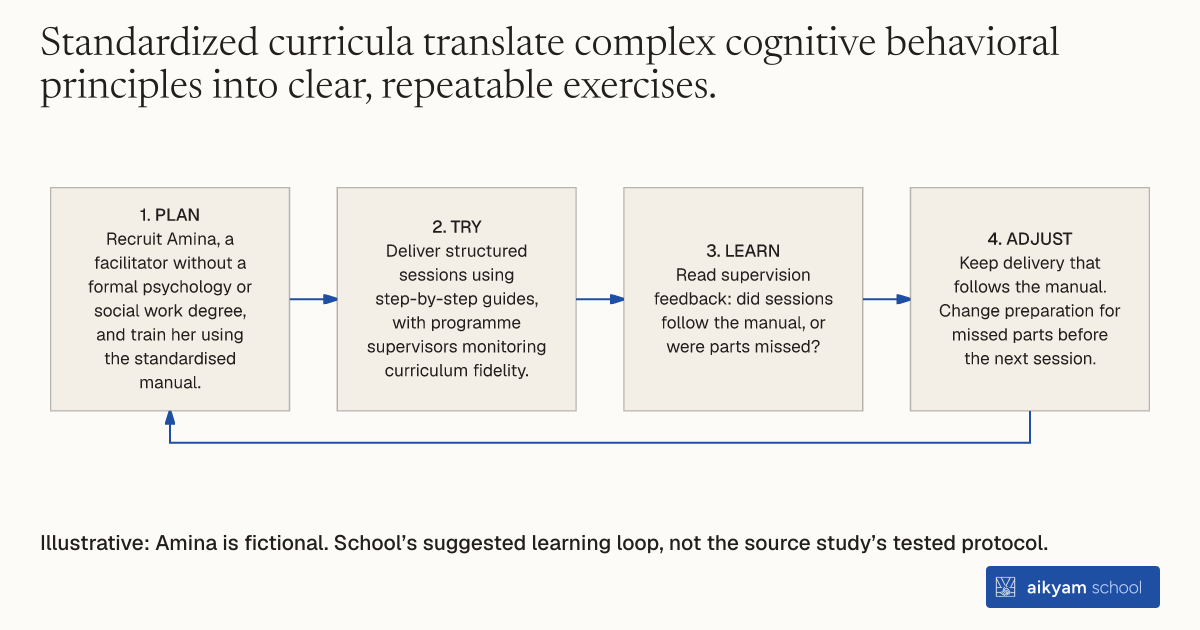
- Plan: Recruit Amina, a facilitator without a formal psychology or social work degree, and train her using the standardised manual.
- Try: Deliver structured sessions using step-by-step guides, with programme supervisors monitoring curriculum fidelity.
- Learn: Read supervision feedback: did sessions follow the manual, or were parts missed?
- Adjust: Keep delivery that follows the manual. Change preparation for missed parts before the next session.
Illustrative: Amina is fictional. School’s suggested learning loop, not the source study’s tested protocol.
See source →School’s suggested, untested loop: observe training and curriculum fidelity. Outcomes from different settings are not guaranteed for this delivery loop.
How
When to use
Behavior change programs face implementation barriers due to the scarcity and high cost of licensed psychologists and social workers. Simplified, standardized behavioral curricula allow delivery by non-specialist personnel. Deploy facilitators without formal social work or psychology degrees to expand program access and lower costs.
Hire and deploy non-specialist facilitators to deliver simple, standardized behavioral intervention curricula across community contexts.
- Program managers recruit community facilitators who do not hold formal degrees in psychology or social work.
- Program staff train non-specialist facilitators using simple, standardized behavioral intervention manuals.
- Facilitators conduct structured group therapy, counseling, or skill-building sessions following step-by-step guides.
- Program supervisors monitor delivery to preserve fidelity to the standardized curriculum.
Why it works
Non-specialists can facilitate these exercises reliably, reducing personnel expenses and enabling widespread scalability.
Example
Evaluations across Liberia, Chicago, Quebec, and El Salvador evaluated behavioral programs delivered by non-specialist facilitators. Programs achieved per-participant costs as low as US\$60, reduced recidivism by up to 60 percent, and generated societal benefit-to-cost ratios from 5-to-1 up to 30-to-1.
About the study
Participants
Youth, incarcerated adults, and police officers across eight evaluation settings in the United States, Liberia, Quebec, and El Salvador.
Study Design
Synthesis of eight experimental and quasi-experimental evaluations testing standardized behavioral interventions delivered by non-specialist facilitators.
Results
Interventions delivered by non-specialists operated at costs ranging from US\$60 to US\$1,850 per participant per year, reduced readmissions by 21 to 39 percent, reduced total arrests by 28 to 35 percent, and produced societal benefit-to-cost ratios up to 30-to-1.