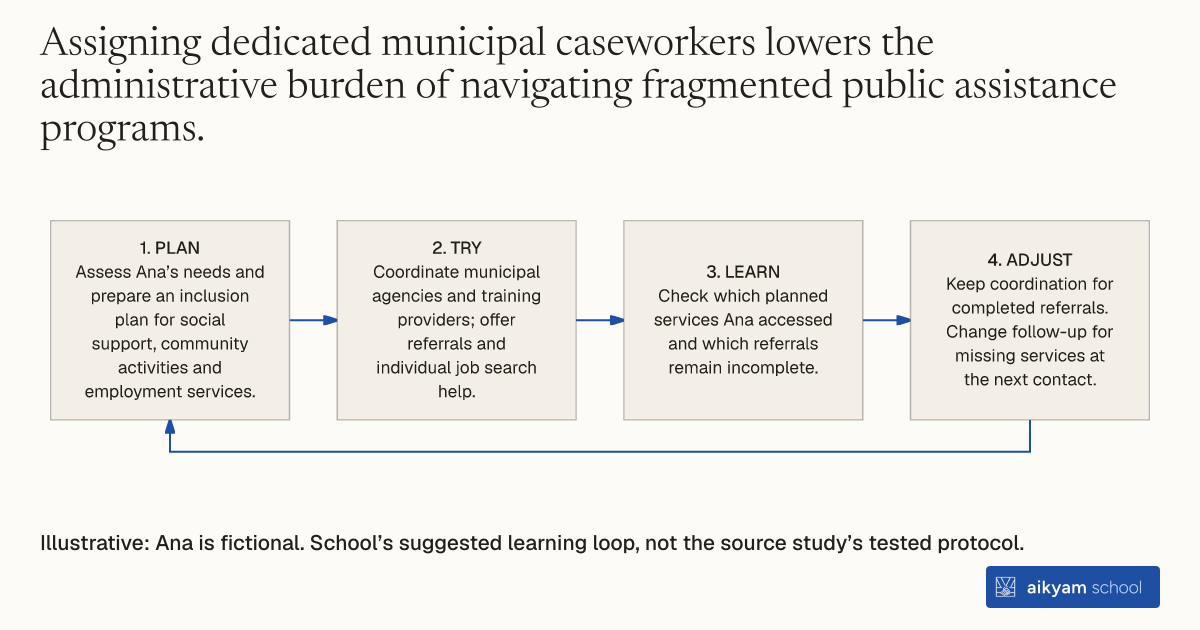
Try, learn and adjust
Check coordinated services reach the participant
- Plan: Assess Ana’s needs and prepare an inclusion plan for social support, community activities and employment services.
- Try: Coordinate municipal agencies and training providers; offer referrals and individual job search help.
- Learn: Check which planned services Ana accessed and which referrals remain incomplete.
- Adjust: Keep coordination for completed referrals. Change follow-up for missing services at the next contact.
Illustrative: Ana is fictional. School’s suggested learning loop, not the source study’s tested protocol.
See source →School’s suggested, untested loop: observe service take-up. The trial did not improve employment outcomes or employment and training programme take-up.
How
When to use
Working-age beneficiaries of social assistance often underutilize available social protection programs due to administrative fragmentation. Standard social service delivery leaves recipients struggling to navigate multiple municipal agencies on their own. This method helps local authorities deliver coordinated intake assessments and personalized social inclusion plans to welfare recipients.
Deliver personalized social support to minimum income scheme recipients through a coordinated municipal service model.
- Specialized caseworkers conduct an initial needs assessment for each enrolled working-age participant.
- Caseworkers create a personalized inclusion plan detailing required social assistance, community activities, and employment services.
- Caseworkers coordinate and monitor service delivery across municipal agencies and training providers.
- Caseworkers refer participants to training in general competencies and vocational skills based on their plan.
- Caseworkers connect participants to community participation activities, public works opportunities, and individual job search assistance.
Why it works
Centralized coordination helps recipients access existing social support services and improves participant mental health.
Example
The Ayuntamiento of Barcelona in Spain implemented a one-stop shop model for 1,183 working-age minimum income beneficiaries over ten months. Specialized caseworkers conducted needs assessments and coordinated social, vocational, and community services. The intervention significantly increased participant take-up of municipal social support programs and enhanced overall mental health.
About the study
Participants
1,183 working-age minimum income scheme beneficiaries (750 treatment group, 433 comparison group) in Barcelona, Spain.
Study Design
Randomised Controlled Trial (RCT) evaluating a 10-month coordinated one-stop shop model implemented by the social services of the Ayuntamiento of Barcelona.
Results
The program increased the take-up of social support programs offered by public social services and enhanced participants' mental health, but did not increase the take-up of employment and training programs or improve employment outcomes.