Try, learn and adjust
Check health and employment support follows the plan
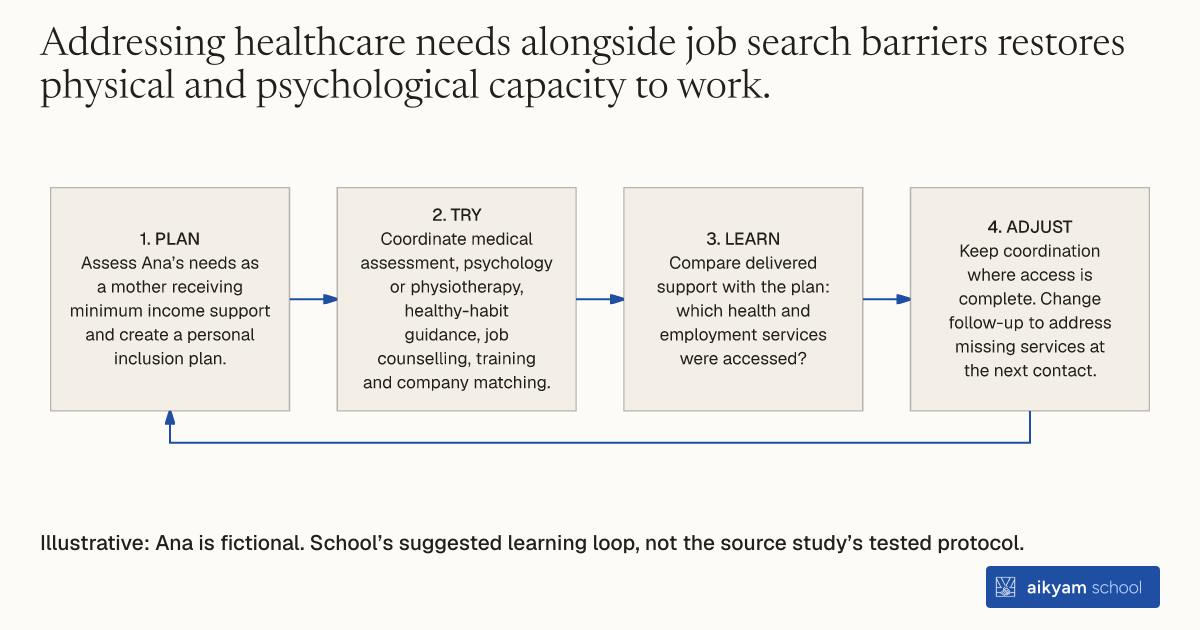
- Plan: Assess Ana’s needs as a mother receiving minimum income support and create a personal inclusion plan.
- Try: Coordinate medical assessment, psychology or physiotherapy, healthy-habit guidance, job counselling, training and company matching.
- Learn: Compare delivered support with the plan: which health and employment services were accessed?
- Adjust: Keep coordination where access is complete. Change follow-up to address missing services at the next contact.
Illustrative: Ana is fictional. School’s suggested learning loop, not the source study’s tested protocol.
See source →School’s suggested, untested loop: observe access to the combined services. Delivery checks do not establish income or health effects.
How
When to use
Low-income mothers receiving social assistance experience health problems and employment barriers that limit earned income. Standard employment programs often overlook physical and psychological health issues that hinder workforce participation. This method combines healthcare diagnosis, therapy sessions, and personalized job search support for vulnerable mothers.
Deliver personalized employment assistance combined with medical diagnoses and health guidance to mothers receiving social protection.
- Social caseworkers conduct an initial assessment to create a personalized inclusion plan for each participant.
- Program healthcare staff perform medical diagnoses and deliver individual psychology or physiotherapy sessions.
- Advisors provide structured guidance on healthy habits to improve overall physical well-being.
- Employment counselors deliver individual job search assistance and counseling on self-employment and entrepreneurship.
- Program staff facilitate direct matching activities with local companies and coordinate targeted vocational training.
Why it works
Combining health and employment support increases job readiness and enables participants to raise earned income.
Example
The Government of Extremadura in Spain delivered a health and employment program to 851 mothers aged 18 to 45 receiving minimum income benefits over two months. Participants received medical diagnoses, physiotherapy or psychology sessions, job search assistance, and firm-matching services. The health intervention improved participants' capacity to secure employment, while employment and combined treatments increased participants' earned income.
About the study
Participants
851 mothers aged 18 to 45 receiving minimum income schemes (214 employment, 214 health, 214 combined, 209 comparison) in Extremadura, Spain.
Study Design
Randomised Controlled Trial (RCT) evaluating a 2-month multi-arm health and employment program implemented by the Government of Extremadura.
Results
The health intervention improved participants' capacity to secure employment, while the employment and combined treatments had a positive impact on earned income, though without identifiable effects on days or hours worked.