Research procedure
Compare reported and measured stove performance
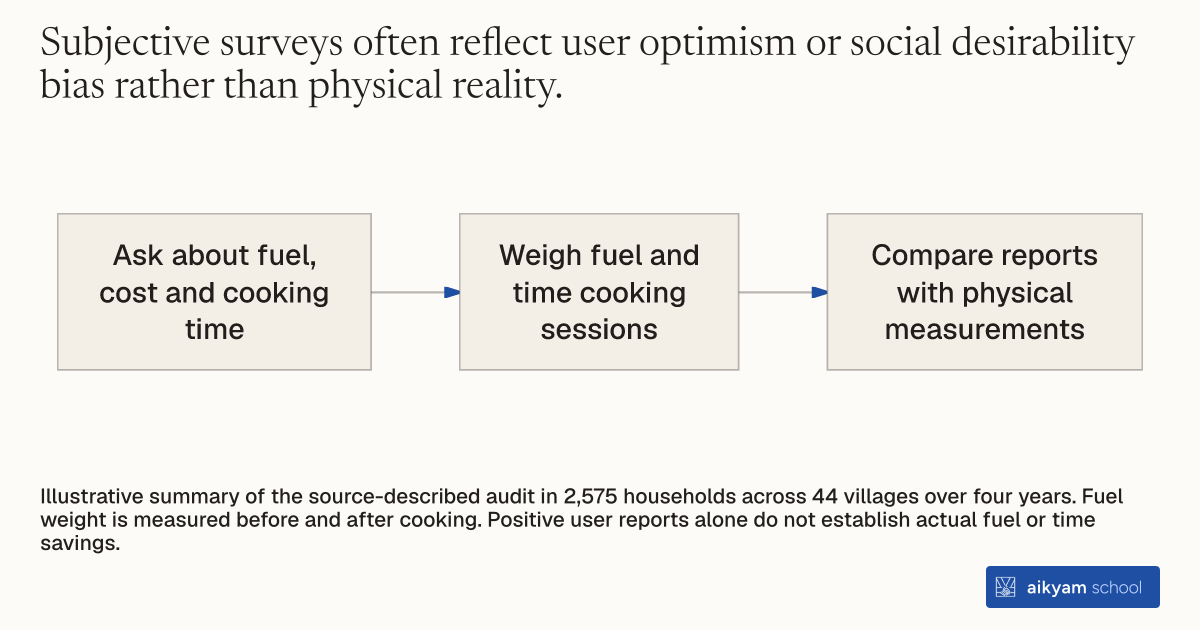
- Ask about fuel, cost and cooking time
- Weigh fuel and time cooking sessions
- Compare reports with physical measurements
Illustrative summary of the source-described audit in 2,575 households across 44 villages over four years. Fuel weight is measured before and after cooking. Positive user reports alone do not establish actual fuel or time savings.
See source →How
When to use
Program managers evaluate technology adoption using household surveys, but self-reported feedback often suffers from perception bias. When assessing energy or time savings, subjective user responses can contradict actual physical performance. Evaluators combine survey questions with objective measurements of fuel weight and cooking duration to detect performance discrepancies.
Audit household fuel consumption and cooking duration by comparing subjective survey responses with direct physical measurements.
- Field evaluators visit sampled households in rural target villages across evaluation waves.
- Evaluators administer survey questionnaires asking households to estimate daily fuel usage, fuel costs, and total cooking time.
- Evaluators collect objective data by measuring fuel wood weights before and after cooking sessions.
- Evaluators measure actual cooking durations across meals using timed observation logs.
- Evaluators compare self-reported user perceptions with objective physical measurements to determine true performance.
Why it works
Auditing self-reports against direct physical measurements isolates true technological savings from perceived benefits.
Example
Evaluators tested 2,575 households across 44 villages in Orissa, India over four years. While households reported in surveys that new stoves performed well by saving fuel and cooking time, objective measurements showed clean stoves caused no significant reduction in actual fuel usage, fuel costs, or cooking duration.
About the study
Participants
2,575 households in 44 rural villages, Orissa, India.
Study Design
Four-year longitudinal Randomized Controlled Trial (RCT) auditing subjective survey responses against objective measures of fuel usage and cooking time across lottery waves.
Results
Clean stoves did not reduce actual fuel usage, fuel expenditures, or cooking time, despite households reporting positive performance on both measures in subjective survey responses.