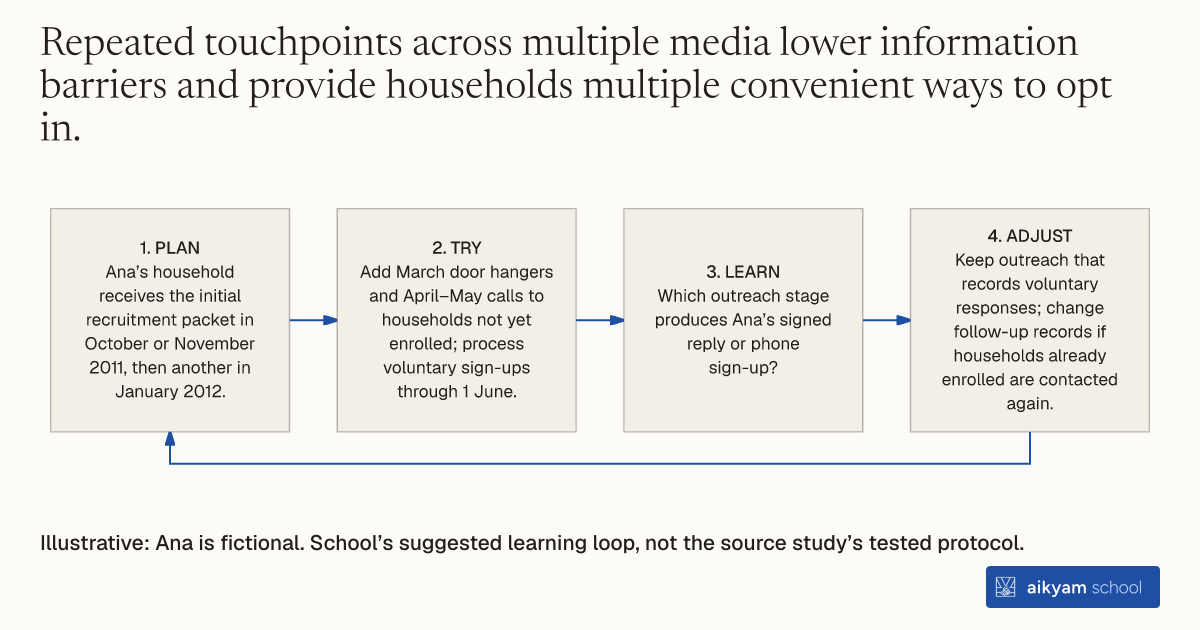
Try, learn and adjust
Check voluntary recruitment responses
- Plan: Ana’s household receives the initial recruitment packet in October or November 2011, then another in January 2012.
- Try: Add March door hangers and April–May calls to households not yet enrolled; process voluntary sign-ups through 1 June.
- Learn: Which outreach stage produces Ana’s signed reply or phone sign-up?
- Adjust: Keep outreach that records voluntary responses; change follow-up records if households already enrolled are contacted again.
Illustrative: Ana is fictional. School’s suggested learning loop, not the source study’s tested protocol.
See source →School’s suggested learning loop, not a tested source procedure. Observe outreach stage, voluntary sign-ups and enrolment status; no response does not constitute enrolment.
How
When to use
Public utilities and energy planners need to recruit residential electricity customers into new time-varying pricing programs. Standard voluntary participation requires active customer engagement to build program awareness and sign-ups. This recruitment strategy targets eligible residential households through repeated multi-channel outreach to encourage voluntary enrollment.
Execute a multi-stage voluntary recruitment campaign using direct mail, door hangers, and phone calls to enroll residential utility customers into pricing programs.
- Program administrators mail an initial recruitment packet containing an informational letter, a brochure, and a postage-paid business reply card to 20 percent of households in October 2011 and 80 percent in November 2011.
- Program administrators mail a second recruitment packet with identical materials to target households in January 2012.
- Field staff place promotional door hangers on targeted household doorknobs in March 2012.
- Phone bank operators make calls almost daily during April and May 2012 to remaining un-enrolled households.
- Enrollment staff process signed business reply cards and phone sign-ups through June 1, 2012.
Why it works
Direct phone calls engage households who ignore postal mail, doubling overall recruitment yields.
Example
SMUD recruited residential households in Sacramento, California for Critical Peak Pricing and Time-of-Use rates between October 2011 and May 2012. Half of enrollees joined during the packet and door hanger phase, while the remaining half joined during the daily phone bank campaign, resulting in approximately 20 percent total opt-in participation across 9,190 CPP opt-in households and 12,735 TOU opt-in households.
About the study
Participants
21,925 residential utility households in Sacramento, California.
Study Design
Randomized controlled trial comparing voluntary opt-in encouragement against control and default opt-out groups.
Results
Approximately 20 percent of households assigned to opt-in encouragement elected to enroll (20.1 percent for CPP and 19.3 percent for TOU), with about half enrolling during mail/door hanger outreach and half during the phone campaign.