Research procedure
Follow households that move away
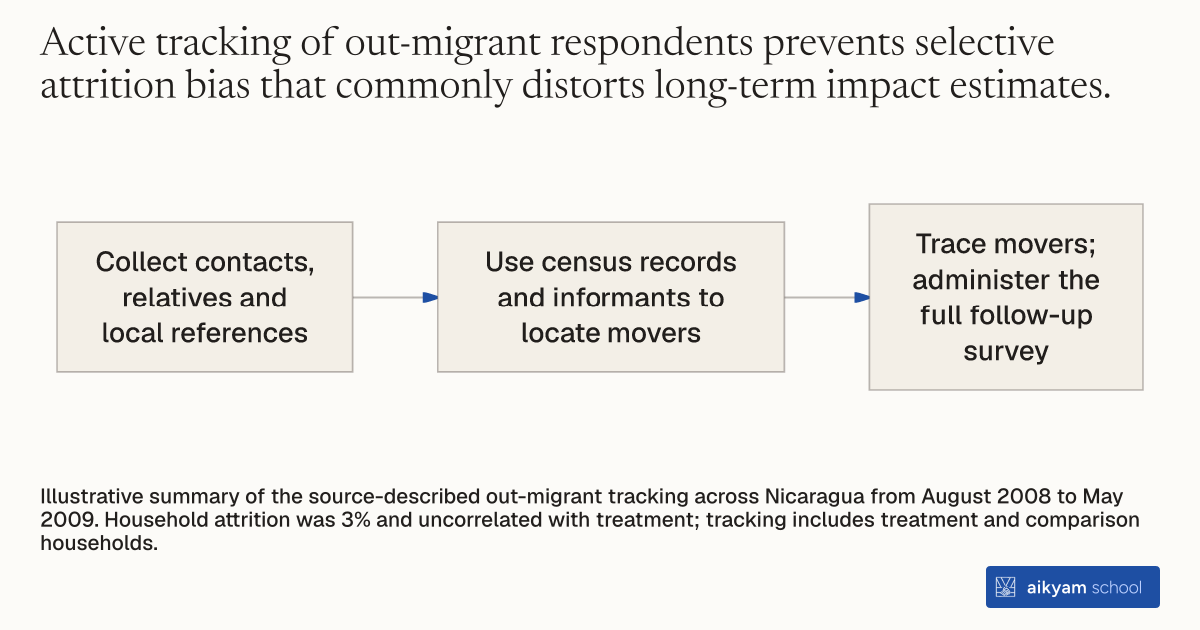
- Collect contacts, relatives and local references
- Use census records and informants to locate movers
- Trace movers; administer the full follow-up survey
Illustrative summary of the source-described out-migrant tracking across Nicaragua from August 2008 to May 2009. Household attrition was 3% and uncorrelated with treatment; tracking includes treatment and comparison households.
See source →How
When to use
Longitudinal field experiments often lose study participants due to geographic mobility and relocation over time. Differential sample attrition creates selection bias and threatens the internal validity of long-term program evaluations. Apply this method when conducting multi-year follow-up surveys among mobile rural populations.
Track study participants who migrate out of original study communities across diverse geographic locations during follow-up data collection rounds.
- Collect detailed baseline locator information, including contact details, relative contacts, and local network references for every household.
- Maintain active contacts through local census records and community key informants prior to follow-up survey rounds.
- Identify individuals and households who moved out of original treatment and control communities between study rounds.
- Deploy field survey teams to trace and interview out-migrants in their new residential locations across regions.
- Administer the full follow-up survey instrument to out-migrant respondents in their target migration destinations.
Why it works
Full follow-up coverage ensures high statistical power and maintains baseline comparability between treatment and control arms.
Example
Between August 2008 and May 2009, field research teams tracked out-migrants from six municipalities in northwestern Nicaragua to new destinations across the country, achieving a ninety-seven percent household retention rate two years post-program.
About the study
Participants
4,000 households (3,000 treatment, 1,000 control) across 106 rural communities in 6 municipalities of northwestern Nicaragua.
Study Design
Longitudinal follow-up survey administered two years after program completion, combining local tracking and nationwide out-migrant interviewing.
Results
Household attrition was restricted to only 3 percent across all study communities, and attrition rates remained completely uncorrelated with assigned treatment status.