Research steps
Link surveys with trailing phone digits
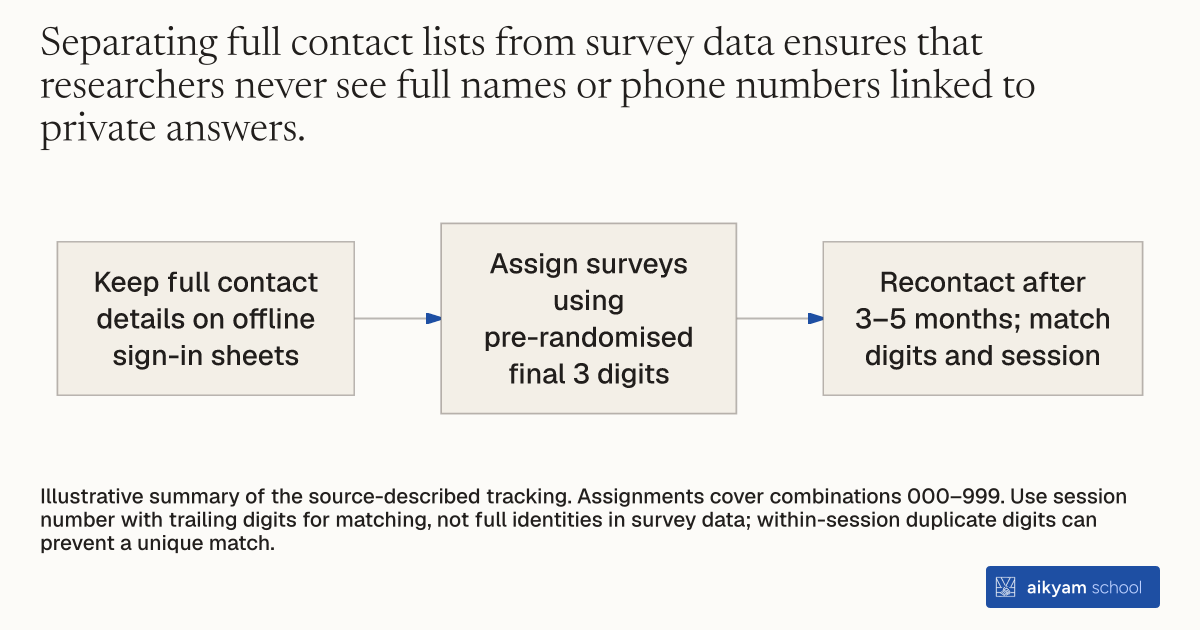
- Keep full contact details on offline sign-in sheets
- Assign surveys using pre-randomised final 3 digits
- Recontact after 3–5 months; match digits and session
Illustrative summary of the source-described tracking. Assignments cover combinations 000–999. Use session number with trailing digits for matching, not full identities in survey data; within-session duplicate digits can prevent a unique match.
See source →How
When to use
In social science studies on sensitive topics, participants may fear social sanctions if their private responses are linked to their personal identities. Direct collection of full contact details within survey tools causes privacy concerns and distorts reported preferences. Tracking participants across experiment rounds using only the trailing digits of their phone numbers protects anonymity while enabling long-term follow-up.
Link baseline survey responses, treatment assignments, and follow-up data without storing full participant identities in survey databases.
- Local surveyor collects participant names and full phone numbers on a physical sign-in sheet before the experiment starts.
- Administrator instructs participants to enter only the last three digits of their phone number into the anonymous survey tool.
- Researcher pre-assigns experimental treatment conditions electronically to all possible three-digit combinations from 000 to 999.
- Survey platform assigns each participant to their pre-randomized treatment condition based on their entered trailing digits.
- Phone surveyor recontacts participants 3 to 5 months later using the offline sign-in list and asks for their last three phone digits during the call.
- Researcher matches follow-up responses to original survey data using the combination of session number and trailing phone digits.
Why it works
Participants feel comfortable sharing truthful opinions on sensitive topics because survey facilitators cannot connect individual responses to real identities.
Example
In Riyadh, Saudi Arabia, researchers tracked 500 married men across 17 session groups in an experiment on female employment norms. By combining session numbers with the last three phone digits, surveyors successfully matched 95% of unique phone numbers during follow-up calls 3 to 5 months later without compromising respondent anonymity.
About the study
Participants
500 married Saudi males aged 18 to 35 across 17 neighborhood session groups in Riyadh, Saudi Arabia.
Study Design
Methodological tracking protocol within a randomized controlled trial combining offline physical sign-in sheets, online anonymous surveys, pre-randomized trailing-digit treatment maps, and follow-up telephone interviews.
Results
Surveyors successfully recontacted 82% of original subjects with unique trailing digits, and 98% of recontacted participants completed the follow-up survey. The trailing-digit matching strategy yielded a 95% successful data match rate across sessions, with only 12 within-session pairs (4.8% of the sample) dropped due to duplicate trailing digits.