Research steps
Recruit from facility rosters and exit surveys
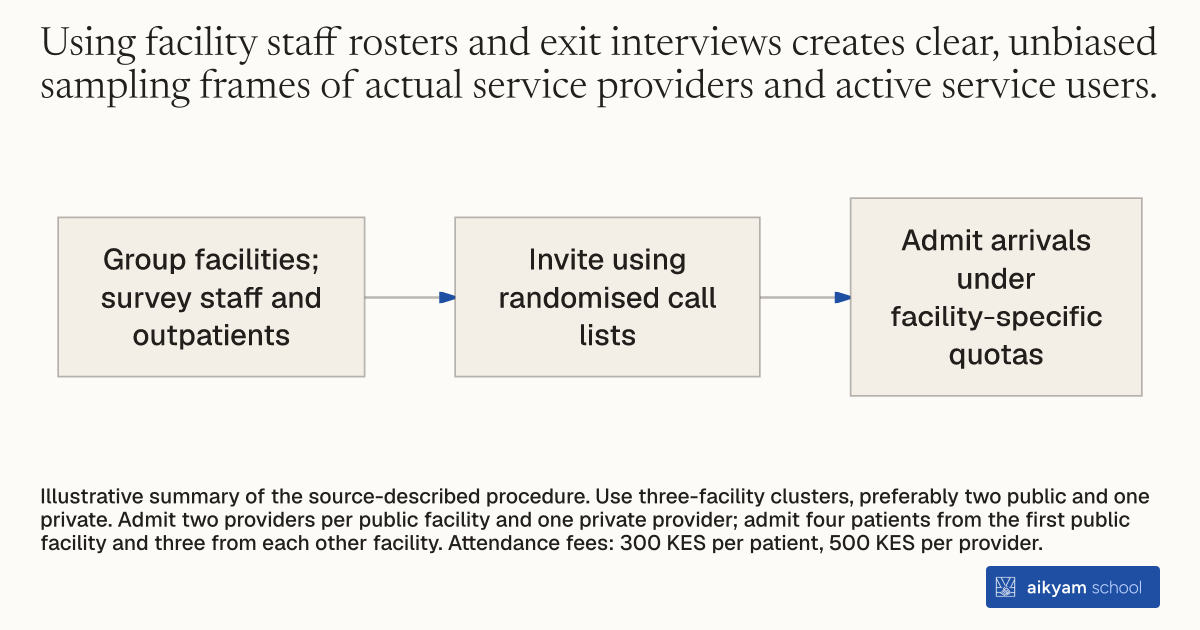
- Group facilities; survey staff and outpatients
- Invite using randomised call lists
- Admit arrivals under facility-specific quotas
Illustrative summary of the source-described procedure. Use three-facility clusters, preferably two public and one private. Admit two providers per public facility and one private provider; admit four patients from the first public facility and three from each other facility. Attendance fees: 300 KES per patient, 500 KES per provider.
See source →How
When to use
Primary health facilities in urban areas need representative sampling frames to recruit real-life healthcare providers and service recipients into research workshops. Traditional open recruitment struggles with low turnout, subject selection bias, and unrepresentative participant pools. This method uses structured exit surveys and cluster-based randomized call lists to sample and recruit health workers and patients.
Recruit representative health providers and outpatients from primary care clinics using exit surveys and randomized cluster call lists.
- Screen a master facility list to identify representative public and private primary care dispensaries and health centers in the target area.
- Group eligible health facilities into geographic proximity clusters of three facilities, assigning two public facilities and one private facility per cluster when possible.
- Station field enumerators at each facility for one week to complete facility surveys, staff rosters, and patient exit interviews.
- Construct a randomized call list from completed staff rosters and outpatient exit surveys to invite participants to a weekend community workshop.
- Over-recruit participants by calling down the ordered list, admitting the first two arriving providers from each public facility, the first arriving provider from the private facility, four arriving patients from the first public facility, and three arriving patients from each remaining facility.
- Pay fixed attendance fees of 300 KES to participating patients and 500 KES to participating health workers upon arrival.
Why it works
Cluster-based geographic sampling and systematic over-recruitment ensure balanced public-private representation and overcome session cancellation risks from participant dropouts.
Example
In Nairobi, Kenya, field teams surveyed 93 public and private dispensaries and health centers across Nairobi County. Teams conducted 1,784 outpatient exit interviews over one-week facility visits and used randomized call lists to recruit 103 health providers and 216 patients across 24 community workshops.
About the study
Participants
1,784 surveyed outpatients and 103 health workers across 93 health facilities in Nairobi, Kenya.
Study Design
Geographic cluster sampling of primary health facilities paired with exit survey recruitment call lists to construct experimental workshop sessions.
Results
The sampling method successfully recruited 216 patients and 103 health workers across 24 workshops with only 1 session canceled due to low attendance, yielding a patient sample that matched the broader 1,784 exit-surveyed population across age (31.1 vs 30.4 years), education (10.4 vs 10.3 years), and asset wealth (-0.06 vs 0.01 index score).