Research design
Randomise firms after matching vacancies
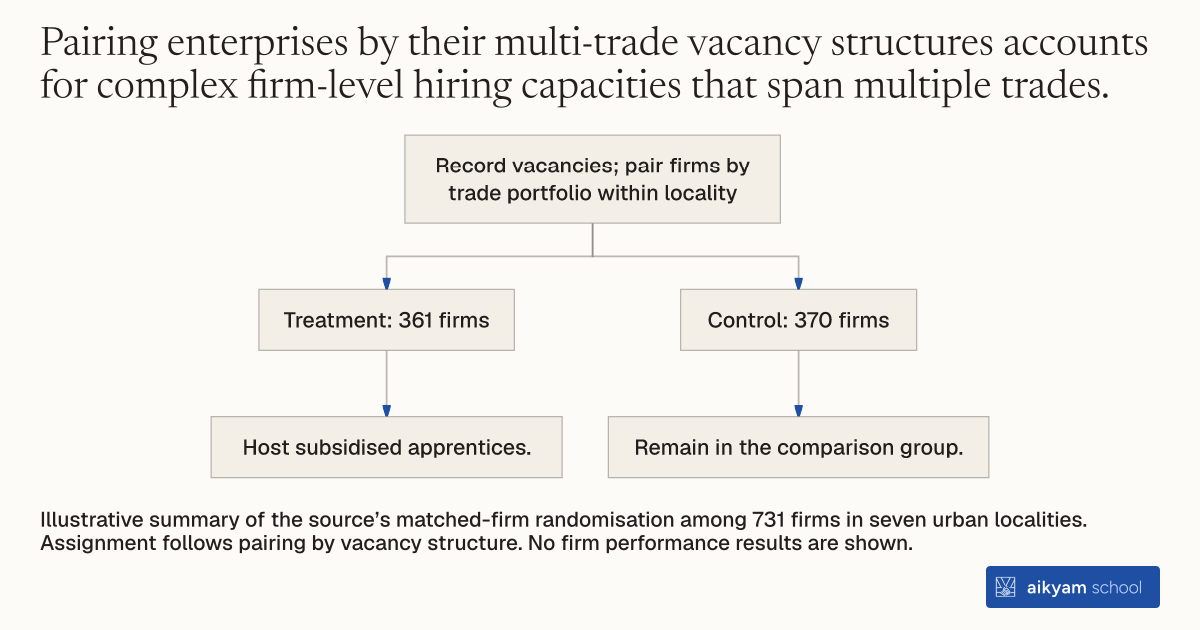
Record vacancies; pair firms by trade portfolio within locality
- Treatment: 361 firms
- Host subsidised apprentices.
- Control: 370 firms
- Remain in the comparison group.
Illustrative summary of the source’s matched-firm randomisation among 731 firms in seven urban localities. Assignment follows pairing by vacancy structure. No firm performance results are shown.
See source →How
When to use
Microenterprises in developing economies often open varying numbers of apprenticeship vacancies across multiple trades within a single business. Standard experimental stratification by single trade fails when multi-trade firms cannot be neatly split into independent strata. Pairing firms based on their exact multi-trade vacancy portfolios before randomizing treatment balances firm-level training capacity across experimental arms.
Pair host microenterprises by trade vacancy structure prior to randomized assignment.
- Survey participating microenterprises to record the exact count and trade breakdown of open apprenticeship positions offered by each firm.
- Group firms offering similar portfolios and numbers of positions across trades within each urban locality.
- Form matched enterprise pairs sharing identical or closely matching trade vacancy portfolios.
- Randomly assign one enterprise within each pair to the treatment group to host subsidized apprentices, while placing the second enterprise in the control group.
Why it works
This matched-pair randomization ensures treatment and control firm groups remain balanced across trade types, firm sizes, and baseline training capacity.
Example
In Côte d'Ivoire, researchers paired 731 informal microenterprises according to their specific vacancy structures across trades within 7 urban localities, randomly assigning 361 firms to host subsidized apprentices and 370 firms to the control group.
About the study
Participants
731 informal microenterprises offering apprenticeship positions across 7 urban localities in Côte d'Ivoire.
Study Design
Matched-pair randomized controlled trial pairing firms by trade vacancy portfolio structure before randomizing treatment within each pair.
Results
Vacancy-structure pairing achieved experimental baseline balance across 731 firms (361 treatment, 370 control), yielding an average of 2.51 open positions per firm (2.45 among follow-up control firms) with no significant baseline differences in permanent workforce (p = 0.50) or apprentice workforce (p = 0.62).