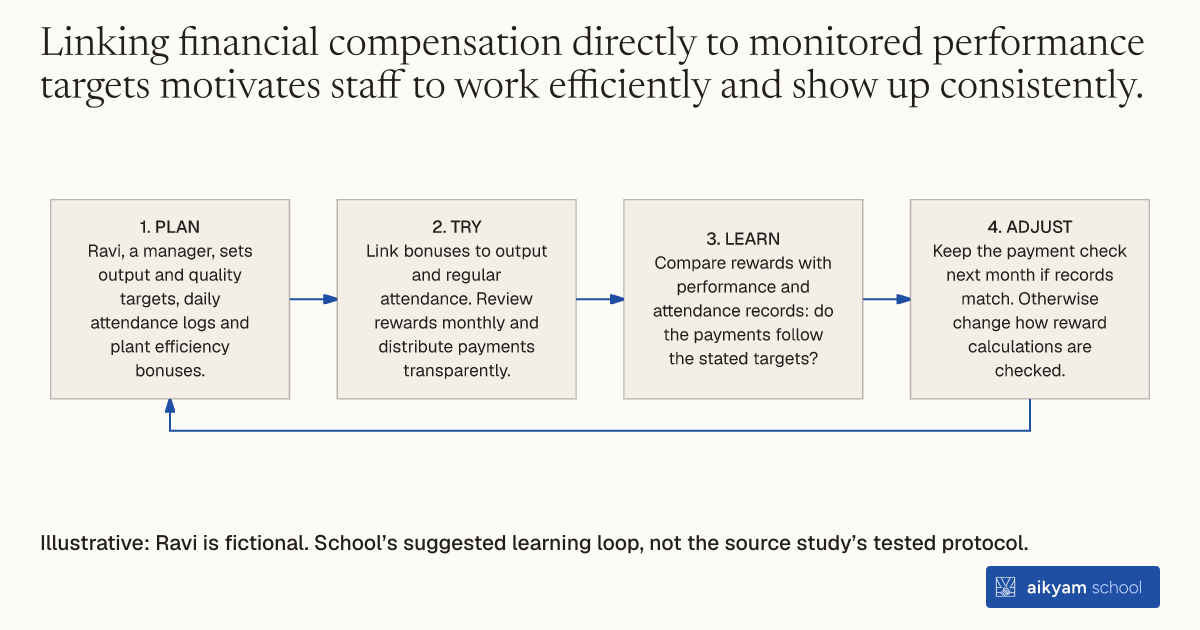
Try, learn and adjust
Check bonuses follow recorded performance
- Plan: Ravi, a manager, sets output and quality targets, daily attendance logs and plant efficiency bonuses.
- Try: Link bonuses to output and regular attendance. Review rewards monthly and distribute payments transparently.
- Learn: Compare rewards with performance and attendance records: do the payments follow the stated targets?
- Adjust: Keep the payment check next month if records match. Otherwise change how reward calculations are checked.
Illustrative: Ravi is fictional. School’s suggested learning loop, not the source study’s tested protocol.
See source →School's suggested, untested loop: observe attendance, output, quality, plant efficiency and bonus payments; no gain is assumed.
How
When to use
Manufacturing plants in developing countries often pay fixed flat wages regardless of individual output or attendance. This lack of performance linkage leads to low worker motivation, reduced daily efficiency, and high absenteeism. Introducing financial incentive schemes ties worker and manager compensation directly to performance targets and attendance.
Establish clear performance targets and financial bonus structures linked directly to measured worker output and attendance.
- Define objective daily output and quality targets for production workers based on plant metrics.
- Establish clear attendance tracking logs to monitor employee presence every day.
- Link financial bonuses directly to achieving daily output targets and regular attendance.
- Set up performance-based bonus structures for factory managers tied to overall plant efficiency.
- Review performance rewards monthly and distribute incentive payments transparently.
Why it works
Rewarding attendance and output aligns individual worker goals with overall plant productivity targets.
Example
Consultants introduced performance-based incentive systems across textile plants owned by seventeen firms around Mumbai, India, increasing worker attendance and operational efficiency.
About the study
Participants
Seventeen large textile manufacturing firms with twenty-eight factory plants around Mumbai, India, averaging 270 employees, US\$13 million in assets, and US\$7.5 million in annual sales per firm.
Study Design
Randomized controlled trial testing an intensive four-month consulting intervention that introduced performance-based incentive pay structures for workers and managers.
Results
Introducing incentive systems increased worker efficiency and attendance, contributing to a 9.4 percent output gain and a 16.6 percent total factor productivity increase within twelve months.