Procedure
Worker rewards
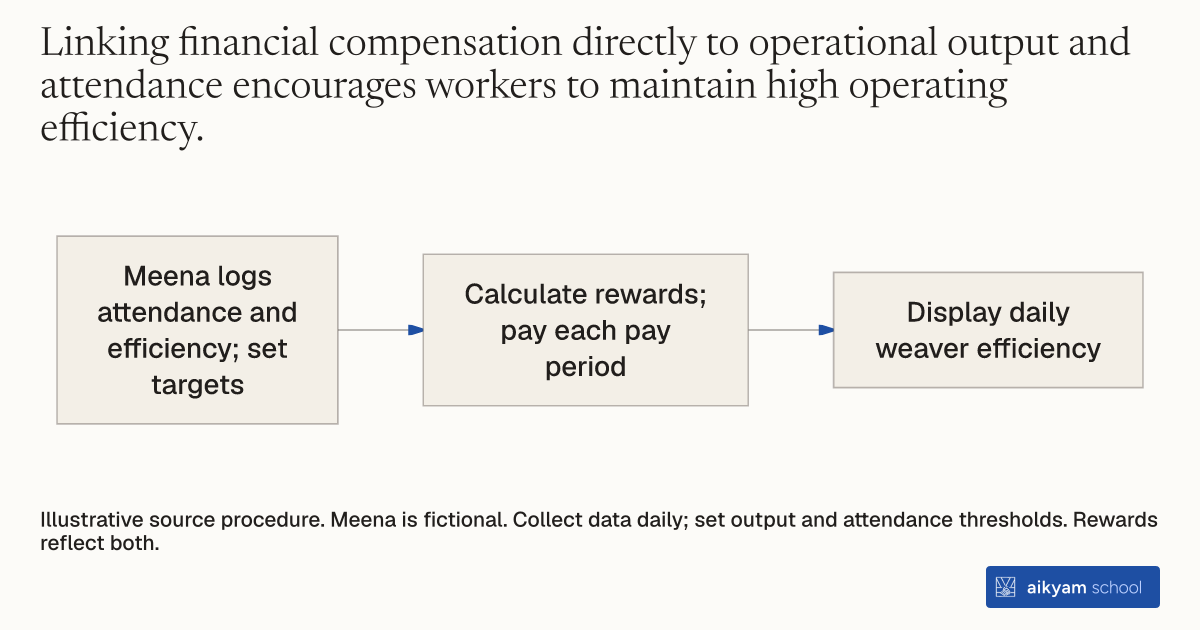
- Meena logs attendance and efficiency; set targets
- Calculate rewards; pay each pay period
- Display daily weaver efficiency
Illustrative source procedure. Meena is fictional. Collect data daily; set output and attendance thresholds. Rewards reflect both.
See source →How
When to use
Factory workers often lack direct monetary motivation to increase daily loom output or maintain consistent attendance. Plant managers rely on flat wages without linking financial rewards to individual production efficiency or regular attendance. This method helps plant directors introduce performance-based and attendance-based incentive schemes for non-managerial factory staff.
Establish performance and attendance reward systems for non-managerial factory staff based on monitored output and attendance records.
- Floor supervisors collect daily attendance and individual production efficiency data for all non-managerial workers.
- Plant managers establish clear output targets and attendance thresholds for factory weavers and helpers.
- Factory directors calculate financial bonuses or rewards tied directly to worker efficiency scores and attendance levels.
- Managers distribute performance and attendance rewards to non-managerial staff each pay period.
- Floor supervisors display daily weaver efficiency metrics to maintain transparency around bonus qualifications.
Why it works
Clear visual tracking of performance allows staff to monitor their own target progress toward financial rewards.
Example
International consultants helped woven cotton textile firms near Mumbai, India evaluate worker performance data, encouraging plant owners to maintain reward systems for non-managerial staff based on operational output and attendance.
About the study
Participants
28 plants across 17 large, family-owned cotton textile weaving firms in Tarapur and Umbergaon near Mumbai, India, averaging 273 employees and \$7.45 million in annual sales per firm.
Study Design
Randomized controlled trial providing 11 treatment firms with 5 months of management consulting and 6 control firms with 1 month of diagnostic consulting, measuring outcomes weekly across ~100 weeks.
Results
Introducing worker incentive schemes alongside visual tracking and operational practices contributed to a 9.4% increase in factory output (p = 0.026) and a 16.6% increase in total factor productivity (p = 0.061), while baseline adoption of performance reward systems for non-managerial staff was 57.1% in treatment plants and 66.7% in control plants.