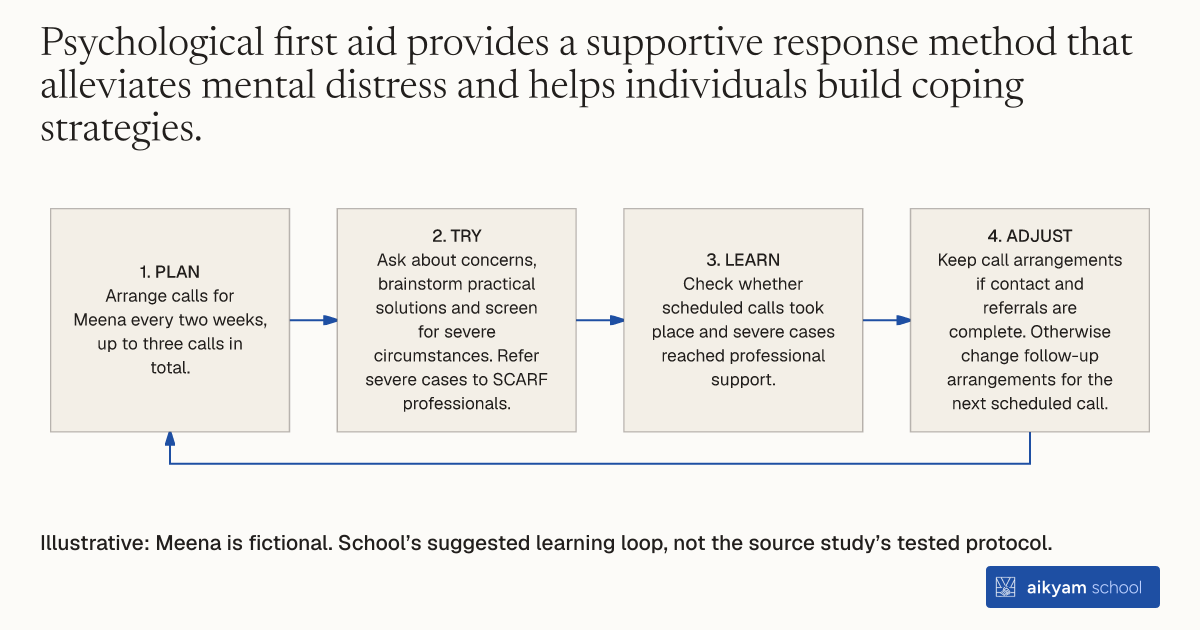
Try, learn and adjust
Check support calls and referrals
- Plan: Arrange calls for Meena every two weeks, up to three calls in total.
- Try: Ask about concerns, brainstorm practical solutions and screen for severe circumstances. Refer severe cases to SCARF professionals.
- Learn: Check whether scheduled calls took place and severe cases reached professional support.
- Adjust: Keep call arrangements if contact and referrals are complete. Otherwise change follow-up arrangements for the next scheduled call.
Illustrative: Meena is fictional. School’s suggested learning loop, not the source study’s tested protocol.
See source →School’s suggested, untested loop: observe completed calls and professional referrals. Research results are forthcoming.
How
When to use
Low-income adults in urban areas face mental distress and social isolation during health crises. A severe shortage of mental health professionals leaves most vulnerable individuals without treatment. Non-specialist phone support delivers accessible psychological first aid to relieve distress and foster resilience.
Deliver phone-based psychological support through non-specialist callers to vulnerable urban adults.
- Non-specialist callers initiate phone contact with participants every two weeks, delivering up to three calls per person.
- Callers ask questions about the participant's primary concerns and thoughts regarding lockdown, isolation, and pandemic stress.
- Non-specialist staff provide basic psychological first aid by assisting participants in brainstorming practical solutions to their problems.
- Callers screen each participant for severe distress, domestic abuse, self-harm ideation, or inability to perform daily activities.
- Non-specialists refer participants exhibiting severe circumstances to trained mental health professionals at SCARF for specialized care.
Why it works
Task-shifting basic supportive listening to non-specialists expands mental health care access in settings with few professional providers.
Example
Schizophrenia Research Foundation (SCARF India) provided up to three biweekly phone calls by non-specialist callers to low-income urban adults in Tamil Nadu, India, during the Covid-19 pandemic.
About the study
Participants
Up to 2,400 urban low-income adults in Tamil Nadu, India, with approximately 800 adults in the psychological support group.
Study Design
Randomized evaluation conducted by J-PAL South Asia and SCARF India, comparing psychological support, cash transfers, and basic service information.
Results
Research ongoing; results are forthcoming.