Try, learn and adjust
Check referral contact details are available
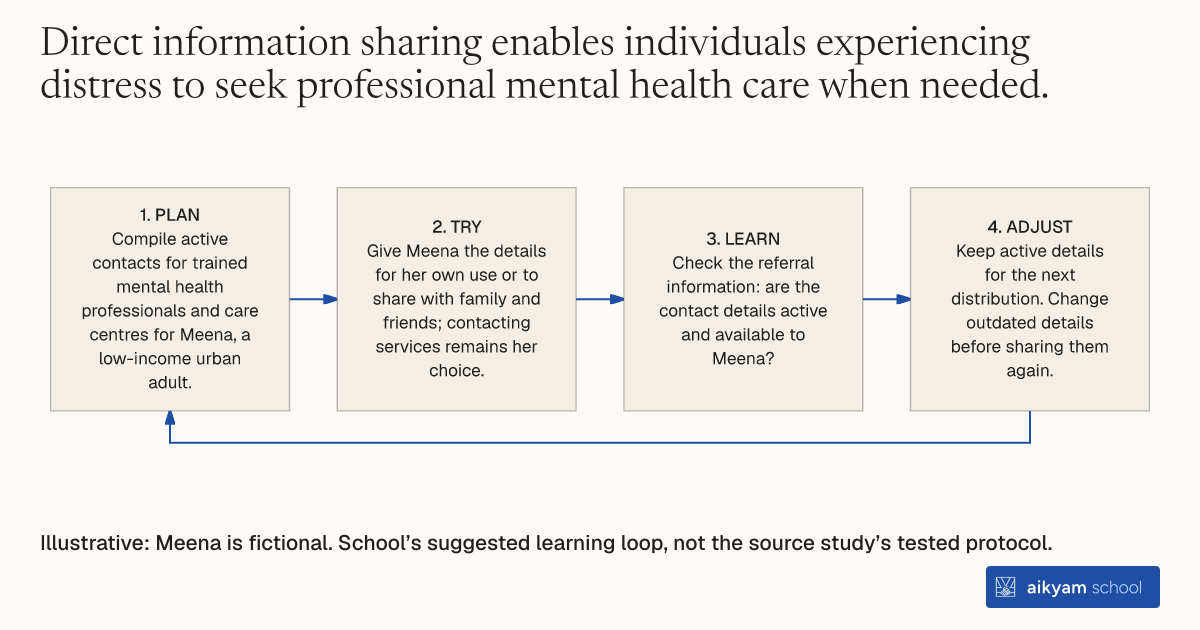
- Plan: Compile active contacts for trained mental health professionals and care centres for Meena, a low-income urban adult.
- Try: Give Meena the details for her own use or to share with family and friends; contacting services remains her choice.
- Learn: Check the referral information: are the contact details active and available to Meena?
- Adjust: Keep active details for the next distribution. Change outdated details before sharing them again.
Illustrative: Meena is fictional. School’s suggested learning loop, not the source study’s tested protocol.
See source →School’s suggested, untested loop. Observe contact information and its distribution. The research is ongoing; no mental health benefit is established.
How
When to use
Low-income urban adults during health crises often lack information on where to access professional mental health support. A severe shortage of providers and high treatment gaps leave many individuals unaware of available care. Providing passive service referral information offers a low-cost baseline to support vulnerable households.
Provide low-income adults with contact details for professional mental health services during a health crisis.
- Identify low-income urban adults seeking or needing support during pandemic lockdowns.
- Compile active contact details for trained psychiatric professionals and mental health care centers.
- Distribute referral details directly to target individuals for their own use or to share with friends and family.
- Allow individuals to independently contact trained mental health professionals if they experience distress.
Example
Researchers provided mental health service referral information to approximately 800 low-income urban adults in Tamil Nadu, India.
About the study
Participants
Up to 2,400 urban low-income adults in Tamil Nadu, India, with approximately 800 adults in the comparison group.
Study Design
Randomized evaluation conducted by J-PAL South Asia and SCARF India.
Results
Research ongoing; results are forthcoming.