Research overview
Pilot questionnaires before the main mailing
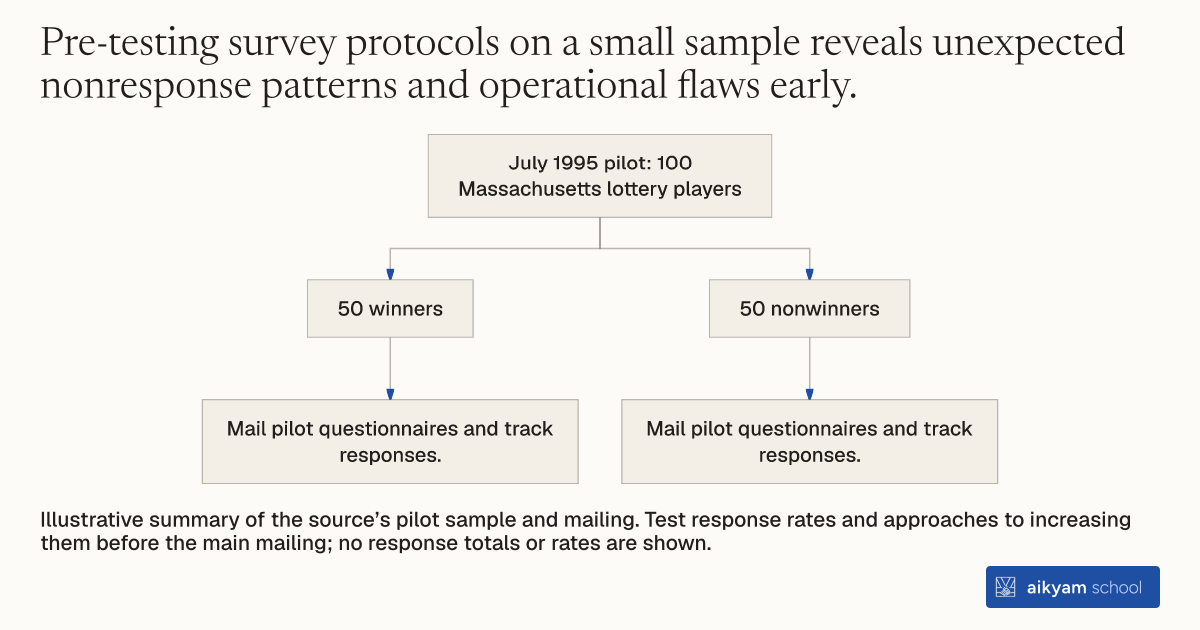
July 1995 pilot: 100 Massachusetts lottery players
- 50 winners
- Mail pilot questionnaires and track responses.
- 50 nonwinners
- Mail pilot questionnaires and track responses.
Illustrative summary of the source’s pilot sample and mailing. Test response rates and approaches to increasing them before the main mailing; no response totals or rates are shown.
See source →How
When to use
Survey organizers face uncertainty when launching large-scale questionnaire mailings to hard-to-reach populations. Untested questionnaire designs, incentive structures, and mailing procedures can lead to low response rates and wasted administrative funds. Administering a small initial pilot survey allows researchers to evaluate baseline response rates and refine incentive schemes before full deployment.
Conduct a preliminary pilot survey on small representative target groups to test questionnaire feasibility and response rates prior to full mailing rollout.
- Select a small random sample of target study participants across major subcategories.
- Prepare preliminary questionnaire packets along with candidate incentive offers.
- Send out pilot survey packages via mail to the selected pilot sample.
- Track returned response rates separately across winner and nonwinner sub-groups.
- Adjust mailing protocols and incentive structures based on pilot response findings before launching the main survey wave.
Why it works
This allows researchers to adjust incentive offers and communication channels before committing resources to full-scale distribution.
Example
Researchers mailed pilot surveys in July 1995 to 50 lottery winners and 50 nonwinners in Massachusetts to evaluate initial response rates. The pilot yielded 17 responses from winners (34 percent response rate) and 25 responses from nonwinners (42 percent response rate), demonstrating the feasibility of the survey instrument before mailing 1,389 surveys in the main wave.
About the study
Participants
100 human lottery players (50 winners and 50 nonwinners) in Massachusetts.
Study Design
Randomized pilot field trial administering preliminary questionnaires via regular mail to measure baseline response rates across winner status.
Results
Pilot mailings achieved a 34 percent response rate among winners (17 returned) and a 42 percent response rate among nonwinners (25 returned), yielding an overall 38 percent pilot response rate.