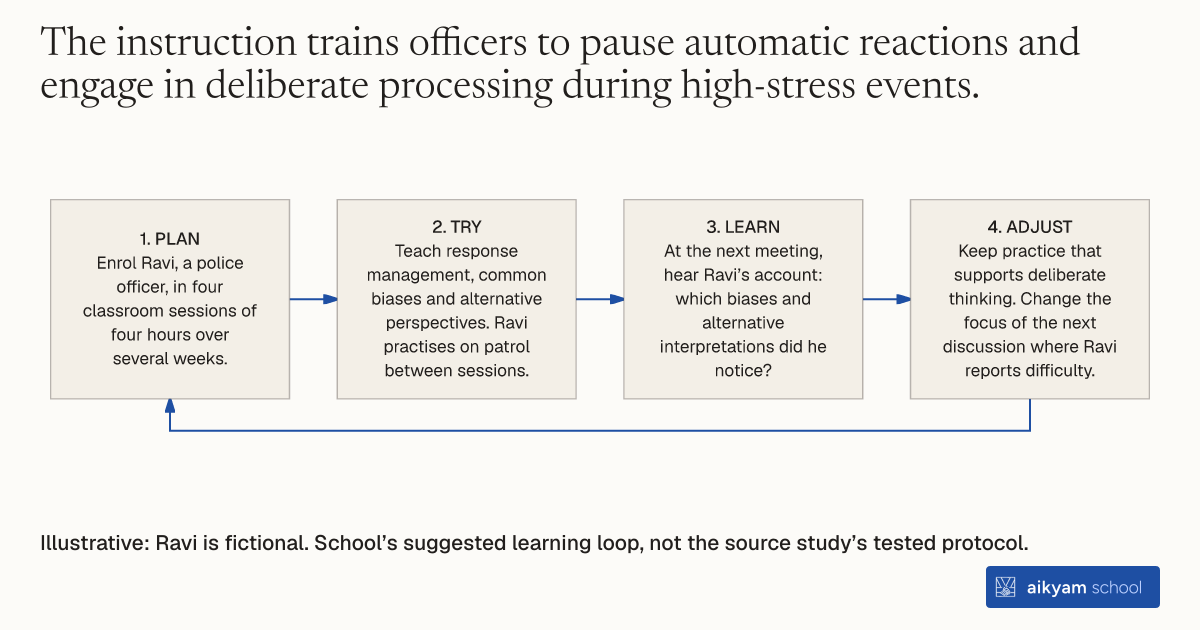
Try, learn and adjust
Check deliberate thinking during patrol
- Plan: Enrol Ravi, a police officer, in four classroom sessions of four hours over several weeks.
- Try: Teach response management, common biases and alternative perspectives. Ravi practises on patrol between sessions.
- Learn: At the next meeting, hear Ravi’s account: which biases and alternative interpretations did he notice?
- Adjust: Keep practice that supports deliberate thinking. Change the focus of the next discussion where Ravi reports difficulty.
Illustrative: Ravi is fictional. School’s suggested learning loop, not the source study’s tested protocol.
See source →School’s suggested, untested loop. Observe patrol experiences discussed between sessions; this does not measure effects on force.
How
When to use
Adverse policing actions like excessive force and unnecessary arrests harm community trust and cause costly injuries. Stressful field conditions force police officers to rely on default assumptions rather than deliberate thinking. This method delivers structured cognitive instruction to help officers manage reactions and make deliberate choices during ambiguous calls.
Deliver a four-session classroom training curriculum that teaches police officers to manage reactions and overcome cognitive biases during field encounters.
- Instructors conduct four classroom sessions of four hours each over several weeks.
- Trainers teach officers to manage emotional and physiological responses during stressful policing situations.
- Instructors train officers to recognize common cognitive biases like catastrophizing and overgeneralizing.
- Trainers prompt officers to intentionally process situational information and construct multiple perspectives on ambiguous scenes.
- Officers practice these cognitive habits during field patrol between sessions and discuss their experiences in following meetings.
Why it works
This practice helps officers gather more information and evaluate alternative interpretations before acting.
Example
Researchers and the Chicago Police Department delivered this 16-hour classroom curriculum over several weeks to 1,059 active police officers in Chicago. Officers practiced recognizing cognitive biases, evaluating multiple perspectives, and applying deliberate processing on duty.
About the study
Participants
2,070 eligible police officers with two or more years of service from all 22 Chicago Police Department districts and specialized units, randomly assigned to 1,059 treatment officers and 1,011 comparison officers.
Study Design
Randomized controlled trial grouping officers by unit and shift time, comparing Sit-D trained officers against control officers taking standard department courses using lab tasks and administrative field records over a one-year period.
Results
Trained officers reduced nonlethal use of force by 23 percent from 38.12 to 29.25 incidents per 1,000 officers per month and discretionary arrests by 23 percent from 36.85 to 28.38 per 1,000 officers per month. Discretionary arrests of Black civilians fell 28 percent from 31.26 to 22.41 per 1,000 officers per month, and injury-related absence days dropped from 1.179 to 0.607 days per month.