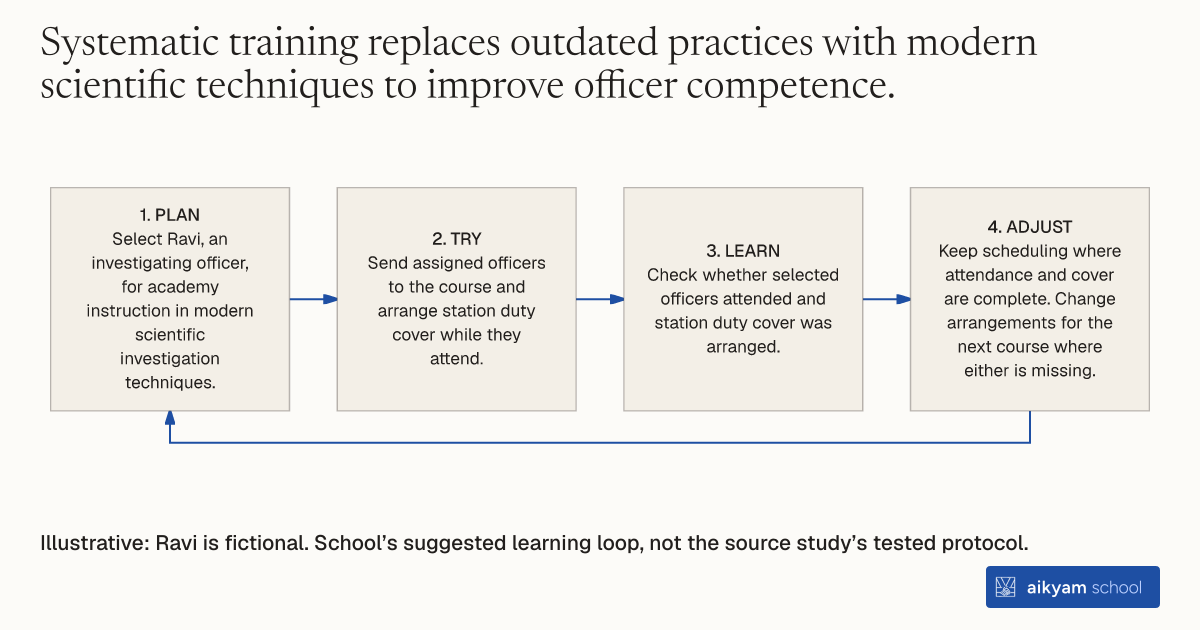
Try, learn and adjust
Check selected investigators attend training
- Plan: Select Ravi, an investigating officer, for academy instruction in modern scientific investigation techniques.
- Try: Send assigned officers to the course and arrange station duty cover while they attend.
- Learn: Check whether selected officers attended and station duty cover was arranged.
- Adjust: Keep scheduling where attendance and cover are complete. Change arrangements for the next course where either is missing.
Illustrative: Ravi is fictional. School’s suggested learning loop, not the source study’s tested protocol.
See source →School’s suggested, untested loop: observe training attendance and station coverage; this check does not establish effects on victim satisfaction.
How
When to use
Police departments suffer from low public satisfaction and outdated investigative habits. Investigating officers often lack formal instruction in modern scientific crime resolution techniques. Police academies deliver targeted in-service courses to build technical competence among investigative personnel.
Provide targeted in-service investigation skills instruction to police officers at a central academy.
- Police leadership selects investigating officers across targeted police stations to attend training.
- Police academy instructors prepare coursework on modern scientific crime investigation techniques.
- Station supervisors send assigned investigating officers to complete the in-service academy course.
- Department administrators coordinate coverage at local police stations while officers complete their training.
Why it works
Training a critical mass of staff creates a shared standard that improves citizen experiences during police encounters.
Example
The Rajasthan Police in India assigned 292 investigating officers to professional skills training at the Rajasthan Police Academy. Training fifty percent of station staff increased crime victim satisfaction by twenty percent, whereas training twenty-five percent produced no noticeable change.
About the study
Participants
162 police stations in 11 districts across Rajasthan, India, serving 70,767 police personnel and 5,895 households.
Study Design
A randomized controlled trial evaluated police stations assigned to send investigating officers to academy training against comparison stations using household surveys and case file reviews.
Results
Eighty-eight percent of selected officers attended training, and training 50 percent of station staff increased victim satisfaction by 20 percent (more than double the baseline average under 30 percent), though training 25 percent produced no change.