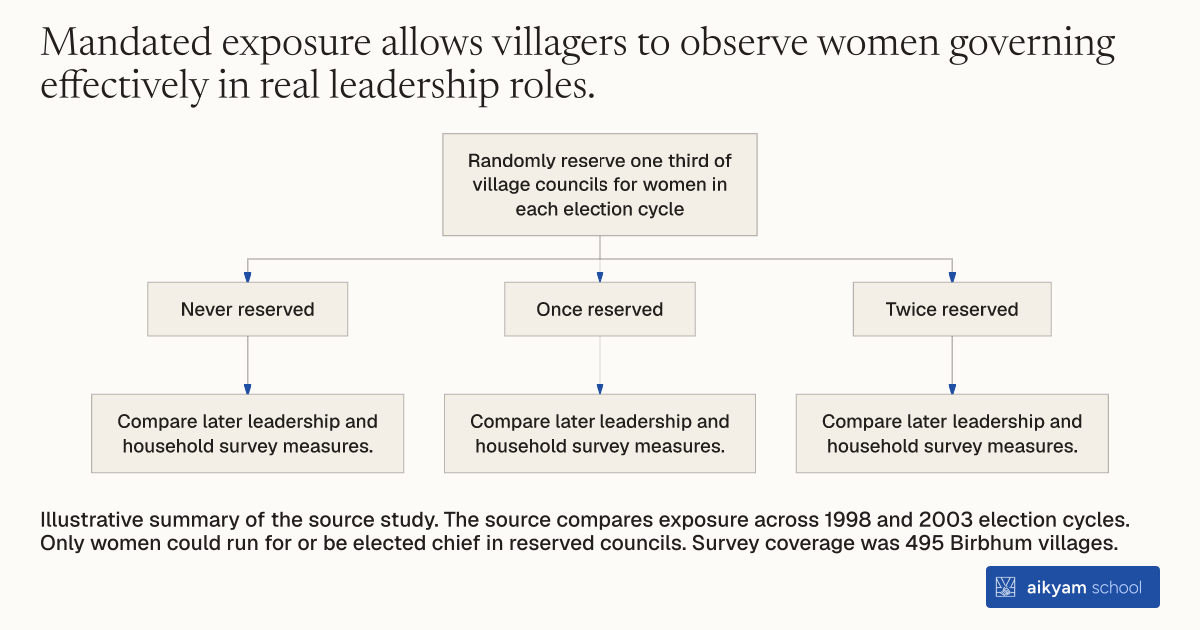
Research design
Compare exposure to reserved leadership
Randomly reserve one third of village councils for women in each election cycle
- Never reserved
- Compare later leadership and household survey measures.
- Once reserved
- Compare later leadership and household survey measures.
- Twice reserved
- Compare later leadership and household survey measures.
Illustrative summary of the source study. The source compares exposure across 1998 and 2003 election cycles. Only women could run for or be elected chief in reserved councils. Survey coverage was 495 Birbhum villages.
See source →How
When to use
Women face systemic underrepresentation in public office and local governance worldwide. Standard electoral processes often fail to overcome deeply entrenched gender stereotypes about leadership ability. Policy makers use mandated political quotas to guarantee female representation in local government for disadvantaged communities.
Mandate a random reservation of local leadership seats specifically for female candidates across electoral cycles.
- State lawmakers pass a constitutional amendment requiring local governments to reserve leadership positions for women.
- Election authorities randomly select one third of village councils in each election cycle to be reserved for female chief councilors.
- Electoral commissions restrict candidate eligibility in reserved village councils so that only women can run for office.
- Local authorities repeat the randomized selection process across consecutive election cycles in 1998 and 2003.
- Councilors elect a female chief councilor who delivers village infrastructure such as public buildings, water, and roads.
Why it works
Seeing female leaders in action improves perceptions of women's capabilities and reduces gender bias over time.
Example
India implemented a constitutional quota reserving one third of village council chief positions for women, which led to 17 percent of chief councilors being women in twice-reserved villages during subsequent unreserved elections compared to 10 percent in never-reserved villages.
About the study
Participants
Surveyed households in 495 randomly selected rural villages in Birbhum district, West Bengal, India, interviewing one male adult, one female adult, and all adolescents.
Study Design
Randomized policy evaluation comparing never-reserved, once-reserved, and twice-reserved village councils across two election cycles in 1998 and 2003.
Results
Female election rates in unreserved elections reached 17 percent in twice-reserved villages compared to 10 percent in never-reserved villages, and adolescent girls in twice-reserved villages were 19 percentage points more likely to want to marry after age 18.