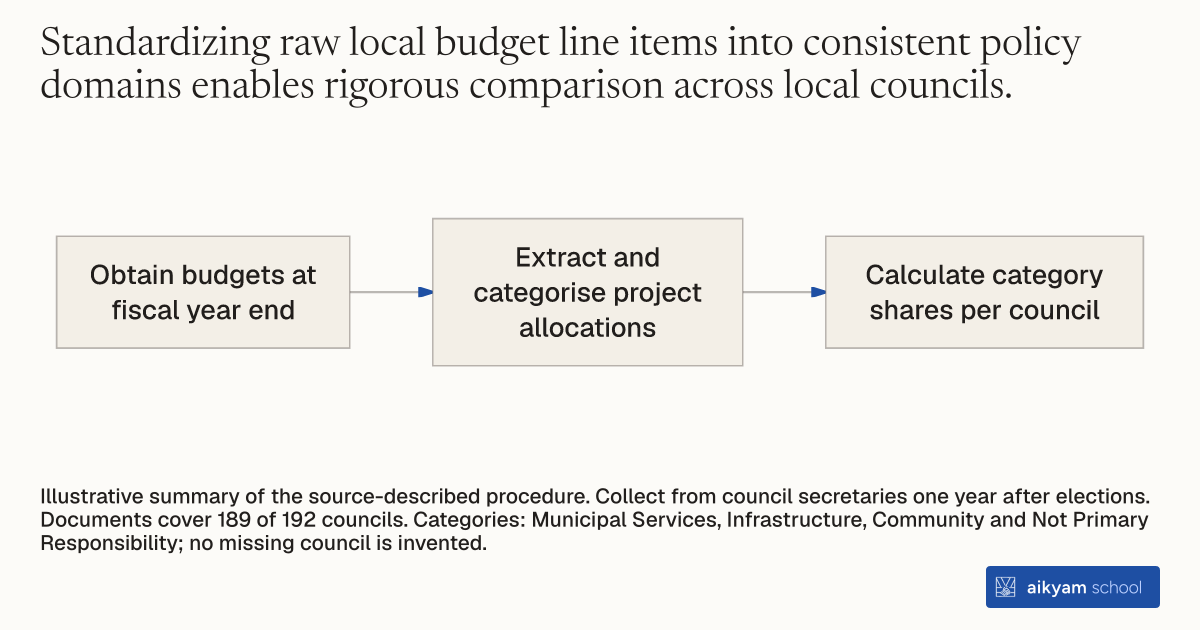
Research steps
Code council development budgets
- Obtain budgets at fiscal year end
- Extract and categorise project allocations
- Calculate category shares per council
Illustrative summary of the source-described procedure. Collect from council secretaries one year after elections. Documents cover 189 of 192 councils. Categories: Municipal Services, Infrastructure, Community and Not Primary Responsibility; no missing council is invented.
See source →How
When to use
Official fiscal data are required to assess whether local elected councils allocate public resources in line with community priorities. Administrative records are often unstandardized across local councils. Collect and code annual development budgets from local council secretaries to evaluate spending patterns across municipal categories.
Collect annual development budget documents from local village council secretaries and code expenditures into standardized policy domains.
- Visit village council secretaries one year after local government elections at the end of the fiscal year.
- Obtain copies of the official development budget documents prepared by each village council and sanctioned by the provincial finance department.
- Extract total monetary expenditure allocations sanctioned for all development projects across each council.
- Categorize every line-item project expenditure into four standardized domains: Municipal Services, Infrastructure, Community, and Not Primary Responsibility.
- Convert category expenditures into percentage shares of total budget spending for each village council.
Why it works
Converting absolute currency allocations into percentage shares allows direct benchmarking against citizen preferences.
Example
In Haripur and Abbottabad districts of Pakistan, researchers returned to sample villages between June and July 2016 to collect development budget documents from 189 village councils. Councils in neutral villages spent on average 29.59% on Municipal Services, 66.07% on Infrastructure, 2.48% on Community projects, and 1.87% on areas outside primary council responsibility.
About the study
Participants
189 village councils in Haripur and Abbottabad districts, Khyber Pakhtunkhwa province, Pakistan.
Study Design
A field data collection and coding protocol gathering official annual development budget documents from council secretaries one year post-election, standardizing expenditures across four functional categories across treatment arms.
Results
Budget documents were retrieved from 189 out of 192 councils; in neutral villages, actual council spending was 29.590% on Municipal Services and 66.069% on Infrastructure, compared to citizen preferences of 66.105% on Municipal Services and 22.588% on Infrastructure.