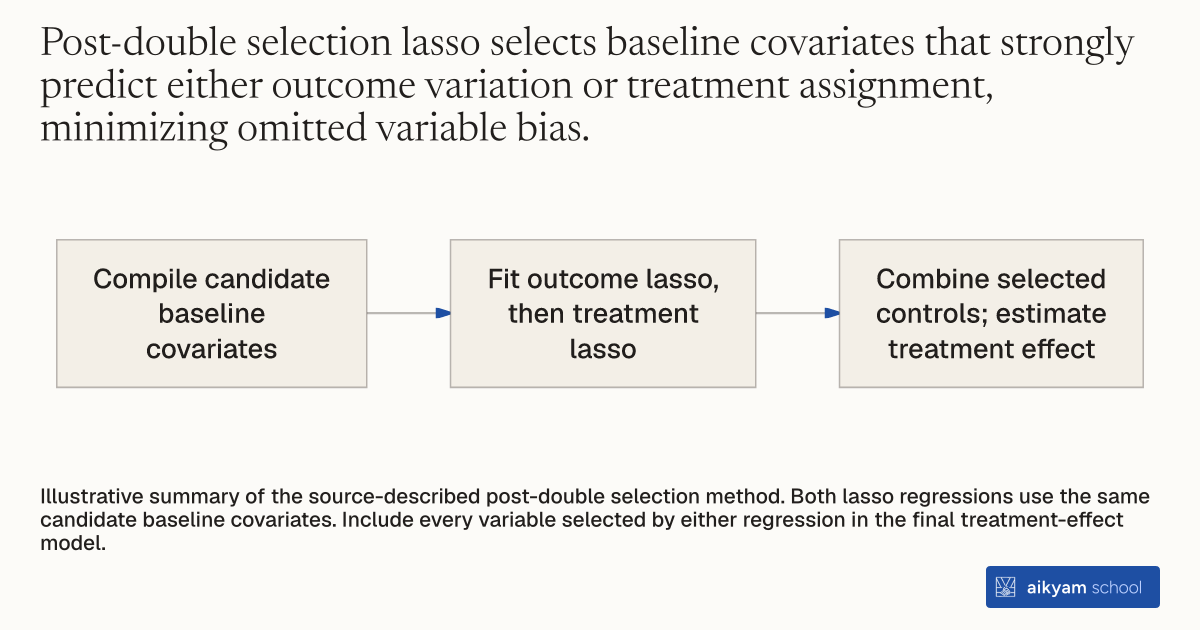
Research steps
Select controls for treatment estimation
- Compile candidate baseline covariates
- Fit outcome lasso, then treatment lasso
- Combine selected controls; estimate treatment effect
Illustrative summary of the source-described post-double selection method. Both lasso regressions use the same candidate baseline covariates. Include every variable selected by either regression in the final treatment-effect model.
See source →How
When to use
In randomized evaluations with small numbers of clusters, researchers face potential baseline imbalances due to chance or selective attrition. Including too many control variables in regression models risks overfitting, while excluding important baseline predictors reduces estimation precision. Applying post-double selection lasso provides a disciplined, data-driven method for selecting baseline control variables that predict both treatment assignment and future outcomes.
Select baseline covariate controls using post-double selection lasso regression to improve treatment effect estimation precision and adjust for baseline imbalances.
- Compile candidate baseline control variables covering respondent demographics, health history, and village infrastructure.
- Run a first lasso regression predicting the primary outcome variable using all candidate baseline covariates.
- Run a second lasso regression predicting treatment assignment status using the same candidate baseline covariates.
- Union the sets of covariates selected by either the outcome prediction lasso or the treatment assignment lasso.
- Estimate the primary treatment effect OLS or fixed-effects regression model including the combined union of selected control variables.
Why it works
This disciplined selection improves statistical precision without introducing researcher bias or overfitting regression models.
Example
In Burkina Faso, evaluators applied post-double selection lasso to select baseline control variables when estimating the impact of a 2.5-year radio campaign across 6,728 women in 16 radio station clusters. Including lasso-selected baseline covariates for the childbirth outcome increased precision, showing that the campaign reduced births in the preceding 12 months from 17.4 percent to 15.9 percent (p-value = 0.06).
About the study
Participants
6,728 women across 252 rural villages in 16 radio station clusters in Burkina Faso.
Study Design
Post-double selection lasso covariate selection algorithm applied to OLS and panel fixed-effects regressions within a cluster RCT.
Results
Post-double selection lasso covariate selection yielded virtually identical treatment estimates for modern contraceptive prevalence while increasing precision on secondary fertility outcomes, revealing a statistically significant reduction in births from 17.4 percent to 15.9 percent (p-value = 0.06).