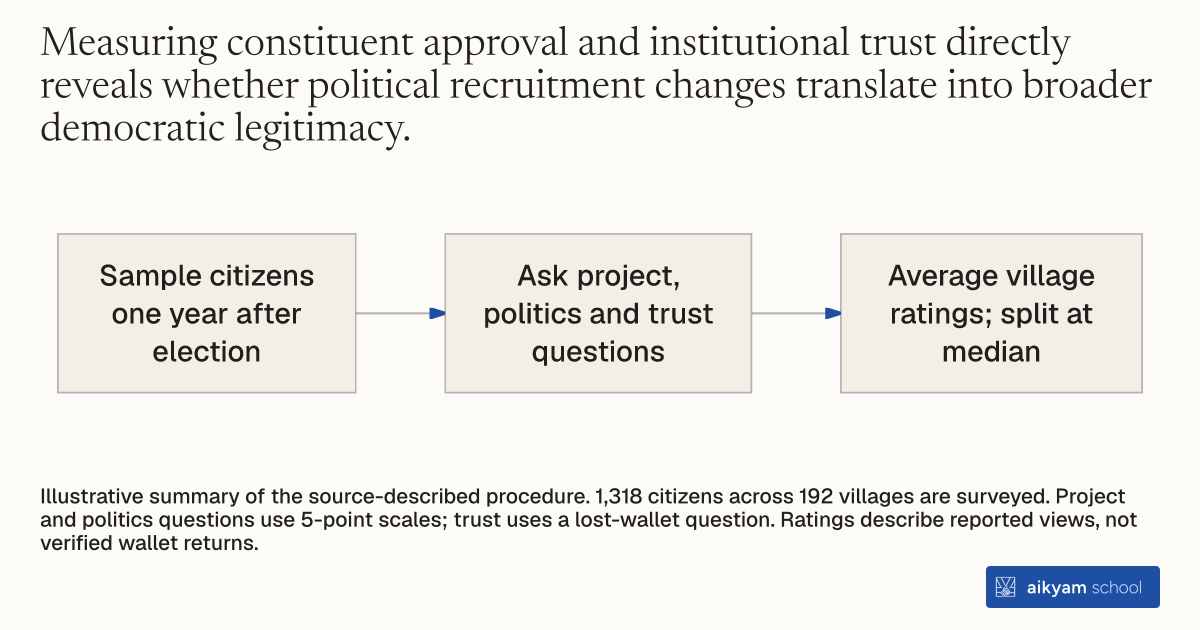
Research steps
Survey project approval and trust
- Sample citizens one year after election
- Ask project, politics and trust questions
- Average village ratings; split at median
Illustrative summary of the source-described procedure. 1,318 citizens across 192 villages are surveyed. Project and politics questions use 5-point scales; trust uses a lost-wallet question. Ratings describe reported views, not verified wallet returns.
See source →How
When to use
Electoral recruitment interventions alter who enters local office and how budgets are spent. Evaluators need to test whether these policy shifts improve constituent satisfaction and public perception of state institutions. Administering a post-election survey captures citizen approval of local development projects and trust in government.
Administer a structured survey to local citizens one year after municipal elections to measure project satisfaction and trust in the state.
- Select a random sample of village residents using a systematic random walk protocol from the village center.
- Ask citizens to rate their approval on a 5-point Likert scale for each development project chosen by the village council.
- Elicit perceptions of politics by asking citizens to rate their agreement on a 5-point scale with the statement that politics is a dirty word.
- Measure trust in public servants by asking respondents the likelihood that a lost wallet would be returned by police or government officials.
- Average individual ratings at the village level and dichotomize outcomes at the median to compare treatment effects across communities.
Why it works
High policy alignment increases public satisfaction with local governance and reduces cynicism toward state institutions.
Example
In Haripur and Abbottabad districts of Pakistan, enumerators surveyed 1,318 citizens across 192 villages one year post-election. In social versus personal villages, citizens were 17.3 percentage points more likely to report satisfaction with council projects and 12.1 percentage points more likely to demonstrate higher trust in state institutions.
About the study
Participants
1,318 citizens across 192 villages in Haripur and Abbottabad districts, Khyber Pakhtunkhwa province, Pakistan.
Study Design
A household survey administered one year after elections using a random walk protocol (every 20th household in four cardinal directions from the village center) to measure approval of council projects and attitudes toward politics and public servants.
Results
Social versus personal messaging increased citizen satisfaction with chosen projects by 17.3 percentage points (p = 0.037), increased disagreement with the negative view of politics by 12.2 percentage points (p = 0.075), and increased overall trust in the state by 12.1 percentage points (p = 0.094).