Research steps
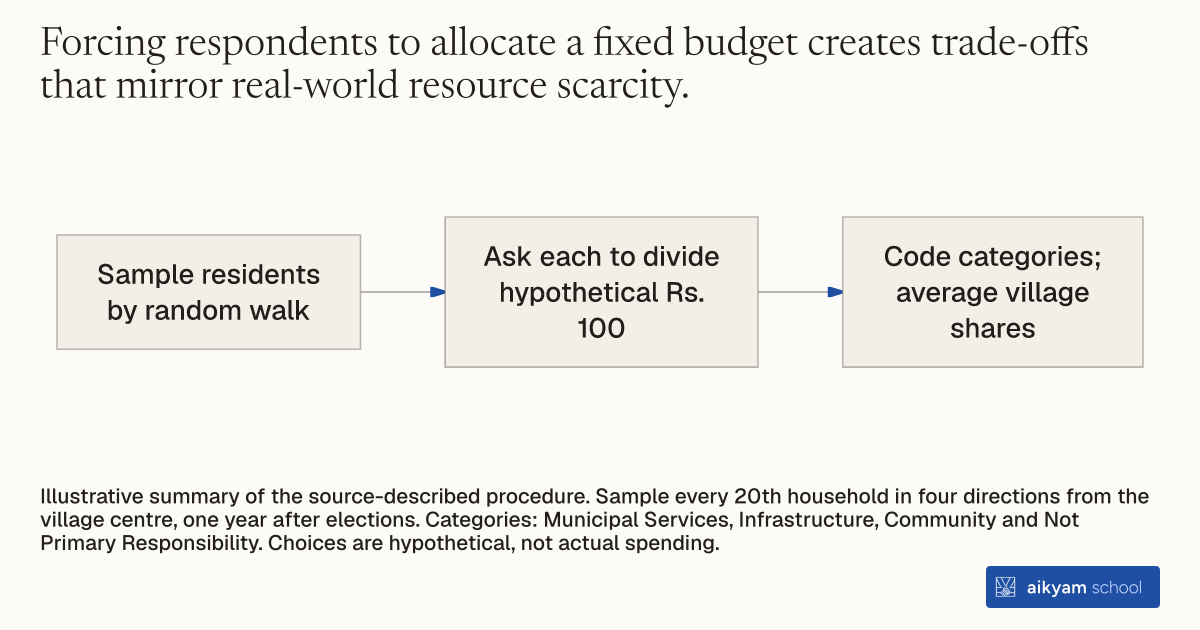
Ask residents to allocate a budget
- Sample residents by random walk
- Ask each to divide hypothetical Rs. 100
- Code categories; average village shares
Illustrative summary of the source-described procedure. Sample every 20th household in four directions from the village centre, one year after elections. Categories: Municipal Services, Infrastructure, Community and Not Primary Responsibility. Choices are hypothetical, not actual spending.
See source →How
When to use
Elected local officials often allocate development funds without understanding constituent spending priorities. Standard surveys fail to capture how citizens prioritize competing public goods under budget constraints. Asking citizens to distribute a fixed currency budget across spending domains reveals clear constituent preferences for local governance.
Survey local citizens using a hypothetical budget exercise to measure spending preferences across municipal categories.
- Select a representative sample of village residents using a systematic random walk sampling protocol from the village center.
- Provide each survey respondent with a hypothetical development budget of 100 Pakistani Rupees.
- Ask the respondent to divide the 100 Rupees across competing local development spending priorities.
- Categorize citizen responses into four standardized policy domains: Municipal Services, Infrastructure, Community, and Not Primary Responsibility.
- Calculate the village-level average percentage allocated by citizens to each of the four spending categories.
Why it works
Aggregating individual choices at the community level generates a precise benchmark of constituent policy priorities.
Example
In Haripur and Abbottabad districts of Pakistan, researchers surveyed 1,318 citizens across local villages one year after municipal elections. When asked to allocate 100 Rupees, citizens assigned on average 66.256% to Municipal Services, 20.639% to Infrastructure, 4.623% to Community projects, and 8.481% to items outside council responsibility.
About the study
Participants
1,318 citizens across 192 villages in Haripur and Abbottabad districts, Khyber Pakhtunkhwa province, Pakistan.
Study Design
A household survey administered one year post-election using a random walk procedure (every 20th household in four cardinal directions from the village center) to elicit hypothetical budget choices across four standardized policy categories.
Results
Citizens in neutral villages allocated on average 66.105% to Municipal Services, 22.588% to Infrastructure, 4.127% to Community, and 7.180% to Not Primary Responsibility, contrasting sharply with actual council spending of 29.590% on Municipal Services and 66.069% on Infrastructure.