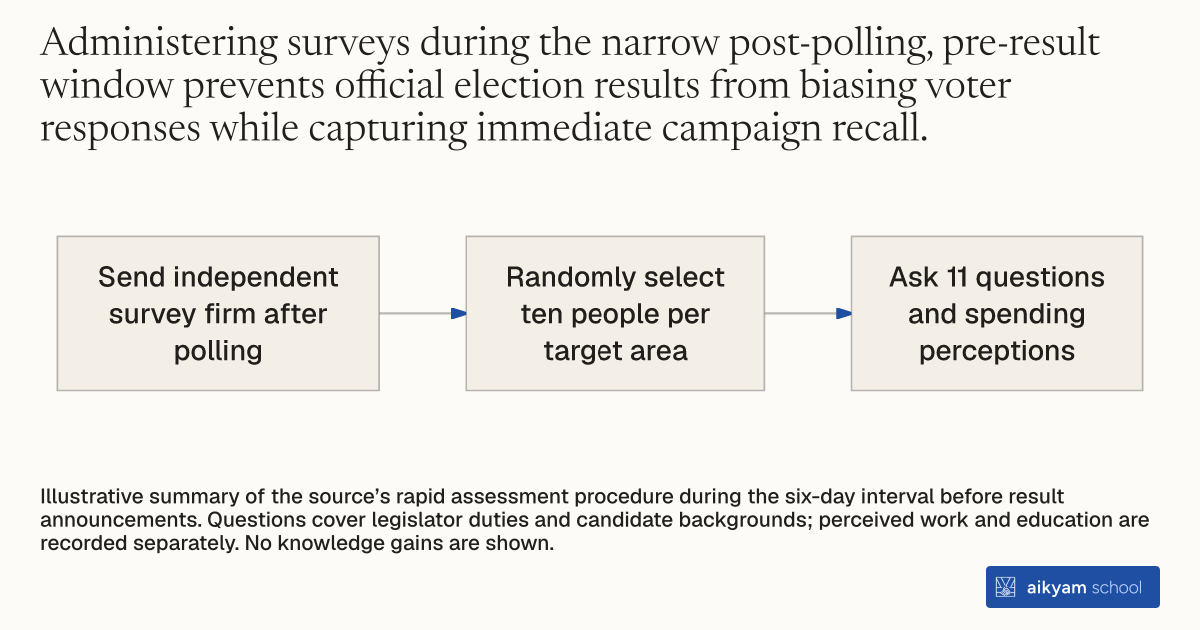
Research procedure
Survey after voting, before results
- Send independent survey firm after polling
- Randomly select ten people per target area
- Ask 11 questions and spending perceptions
Illustrative summary of the source’s rapid assessment procedure during the six-day interval before result announcements. Questions cover legislator duties and candidate backgrounds; perceived work and education are recorded separately. No knowledge gains are shown.
See source →How
When to use
Evaluating the impact of voter transparency campaigns on citizen knowledge in low-income democracies is difficult because voters may confuse campaign materials with political rumors. Administering a brief, structured pop-quiz survey to households immediately after polling reveals whether citizens retained factual governance data. This helps program evaluators distinguish factual knowledge gains from general voter sentiment changes across diverse literacy levels.
Administer a post-election pop-quiz survey to randomly selected slum households to measure candidate knowledge and local spending perceptions.
- Deploy an independent survey firm with no links to project implementation during the six days between polling day and election result announcements.
- Select ten individuals at random from each targeted polling station slum neighborhood to administer a brief eleven-question pop-quiz.
- Test factual recall of legislator responsibilities, including discretionary fund allocations, government oversight committee roles, and candidate background affidavits.
- Measure voter perceptions of local development by asking respondents to rank legislator performance across major public good categories as having done a lot, some, or no work.
- Record respondent formal education levels to analyze knowledge retention across literate and illiterate citizens.
Why it works
Asking specific factual questions alongside subjective spending rankings separates genuine factual learning from overall candidate approval.
Example
An independent survey company surveyed 3,898 residents across 388 Delhi slum neighborhoods during the six days between voting and result announcements in November 2008.
About the study
Participants
3,898 respondents (1,946 control, 1,952 treatment) across 388 polling stations in low-income slums in Delhi, India, with average monthly household income around 6,500 Rupees.
Study Design
Randomized controlled trial administering a post-poll 11-question knowledge quiz and perception survey across 200 treatment and 200 control slums.
Results
Educated treatment respondents improved total quiz score by 10 percent (0.28 points out of 11), while treatment respondents in slums with higher local road spending were significantly more likely to perceive that the incumbent did a lot of work on roads.