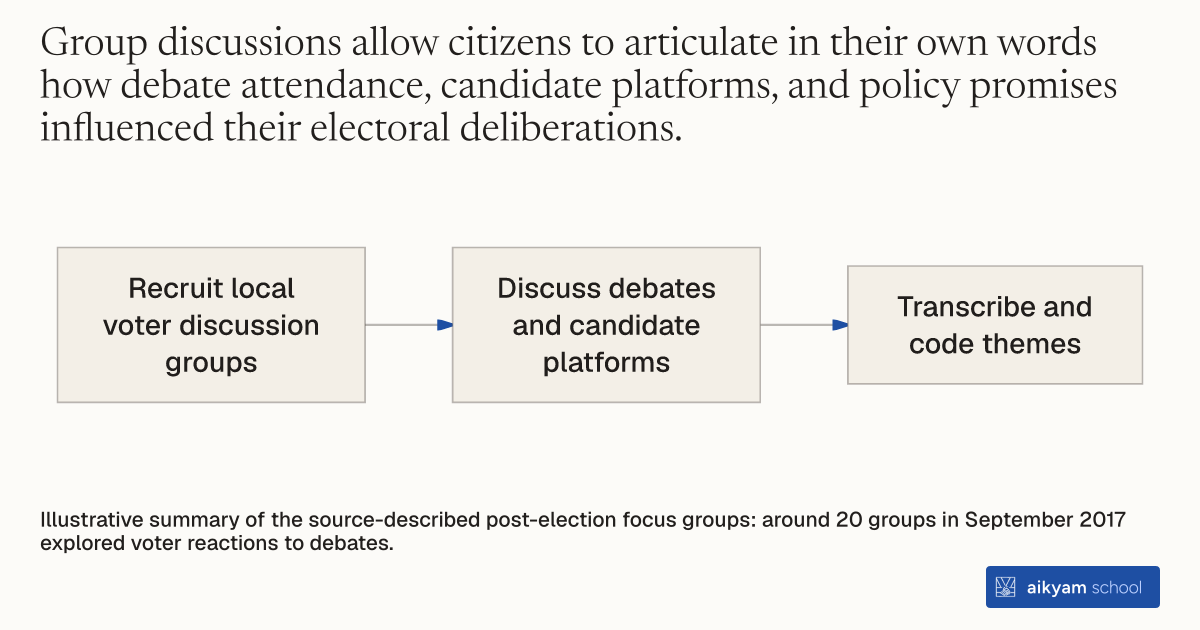
Research discussions
Explore voter reactions to debates
- Recruit local voter discussion groups
- Discuss debates and candidate platforms
- Transcribe and code themes
Illustrative summary of the source-described post-election focus groups: around 20 groups in September 2017 explored voter reactions to debates.
See source →How
When to use
In political economy evaluations, quantitative panel surveys measure statistical changes in voter choices but cannot fully reveal how citizens construct meaning from new policy platforms. Evaluators need qualitative insights to understand how voters interpret debate content, candidate absence, and platform credibility. This method conducts post-election focus groups with community voters to explore qualitative mechanisms driving voting behavior.
Evaluate citizen perceptions and mechanisms by conducting qualitative post-election voter focus group discussions.
- Select representative towns and communities across rural and urban electoral districts following candidate debates and national elections.
- Recruit small groups of local registered voters reflecting diverse community demographics.
- Facilitate structured group discussions led by trained qualitative researchers shortly after election day.
- Prompt participants to discuss their impressions of candidate debate participation, candidate platform specificity, and changes in their voting mindsets.
- Record and transcribe focus group discussions, systematically coding qualitative themes regarding voter reactions and candidate platform quality.
Why it works
Qualitative insights validate quantitative survey findings by revealing the precise reasoning voters used to judge incumbents and challengers.
Example
Researchers conducted approximately 20 focus group discussions across Liberian towns including Vai Town, Foya, Kolahun, Massabolahun, Klay, and Voinjama in September 2017 following candidate debates. Participants explained that debates introduced them to policy platforms, highlighted candidate absences, and altered their voting preferences based on candidate performance.
About the study
Participants
Around 20 focus group discussions conducted with local registered voters across multiple electoral districts in Liberia in September 2017.
Study Design
Qualitative post-election focus group evaluation deployed alongside a randomized field experiment and voter panel survey to investigate mechanisms underlying citizen learning and candidate assessment.
Results
Qualitative accounts demonstrated that citizens found policy platforms novel, noticed candidate absences, updated candidate competence assessments, and noted that challenger policy platforms were often weaker and less detailed than incumbent platforms.