Research panel
Survey voters before and after debates
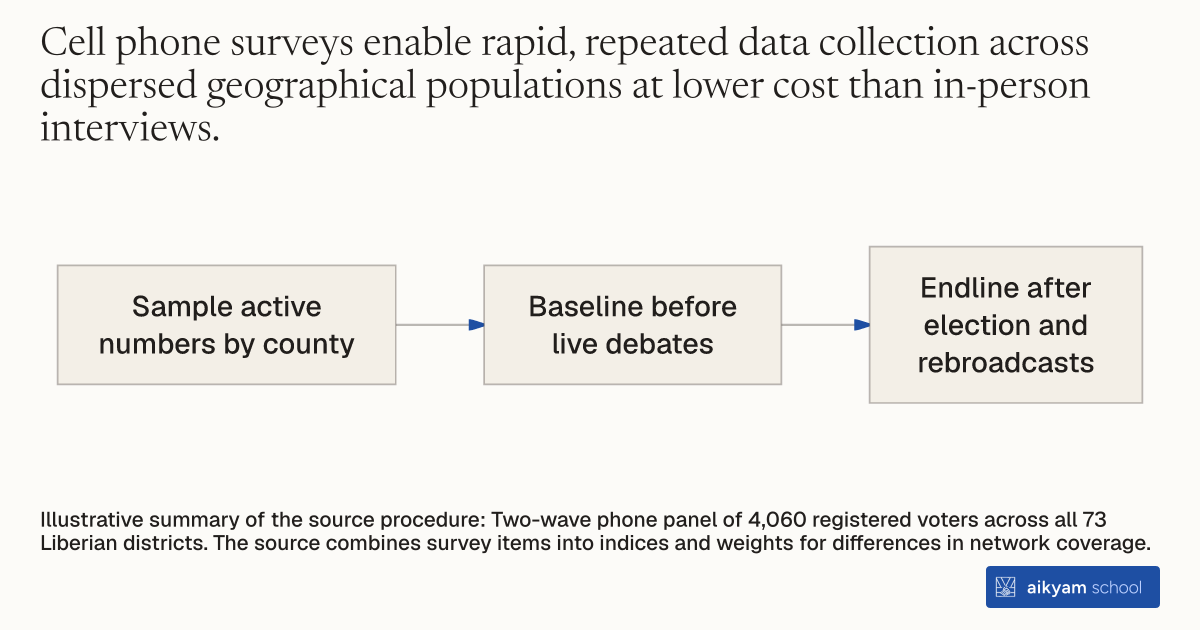
- Sample active numbers by county
- Baseline before live debates
- Endline after election and rebroadcasts
Illustrative summary of the source procedure: Two-wave phone panel of 4,060 registered voters across all 73 Liberian districts. The source combines survey items into indices and weights for differences in network coverage.
See source →How
When to use
In low-income countries with poor infrastructure and high rural dispersion, conducting multiple face-to-face household survey rounds during an election campaign is prohibitively expensive and time-consuming. Researchers and evaluators need a reliable, cost-effective method to track individual voter beliefs, policy knowledge, and political behavior before and after informational interventions. This approach surveys a nationally representative panel of registered voters via cell phone interviews.
Track voter beliefs and political behavior across an electoral campaign by conducting a two-wave cell phone panel survey.
- Draw a random sample of active mobile phone numbers from the primary cellular network operator in the target country, pre-stratifying at the county level to ensure geographical coverage.
- Employ trained enumerators using computer-assisted telephone interviewing software on tablet computers to contact respondents.
- Administer a baseline survey ahead of live candidate debates to measure demographic characteristics, baseline candidate preferences, baseline policy priorities, and initial certainty regarding candidate competence.
- Administer an endline survey round following the campaign and debate rebroadcasts to evaluate changes in debate listening, factual policy knowledge, political discussion, candidate evaluations, and self-reported vote choices.
- Apply standardized z-score indices to aggregate related survey items and weight observations by inverse respondent counts or district registration counts to adjust for differential mobile network penetration across rural and urban districts.
Why it works
Panel tracking allows researchers to observe individual-level changes in candidate knowledge, policy alignment, and voter turnout while controlling for baseline beliefs.
Example
Researchers partnered with GeoPoll and NORC to conduct a two-wave panel survey of 4,060 registered Liberian voters across all 73 electoral districts during the 2017 legislative elections. The baseline survey ran in August 2017, followed by an endline survey post-election to measure how political candidate debates influenced voter policy knowledge and electoral choices.
About the study
Participants
4,060 registered voters across all 73 electoral districts in Liberia (75% male, average age 31.7 years, 50% with secondary or university education).
Study Design
Two-wave mobile phone panel survey (baseline in August 2017 before live debates; endline after October 2017 election) using computer-assisted telephone interviewing from a random sample of active cell phone numbers.
Results
Measured a 0.304 standard deviation increase in debate listening index, a 0.125 standard deviation increase in debate factual knowledge, a 0.156 standard deviation increase in CSDF policy knowledge, and a 0.251 standard deviation increase in political information demand in treated high-intensity invitation districts.