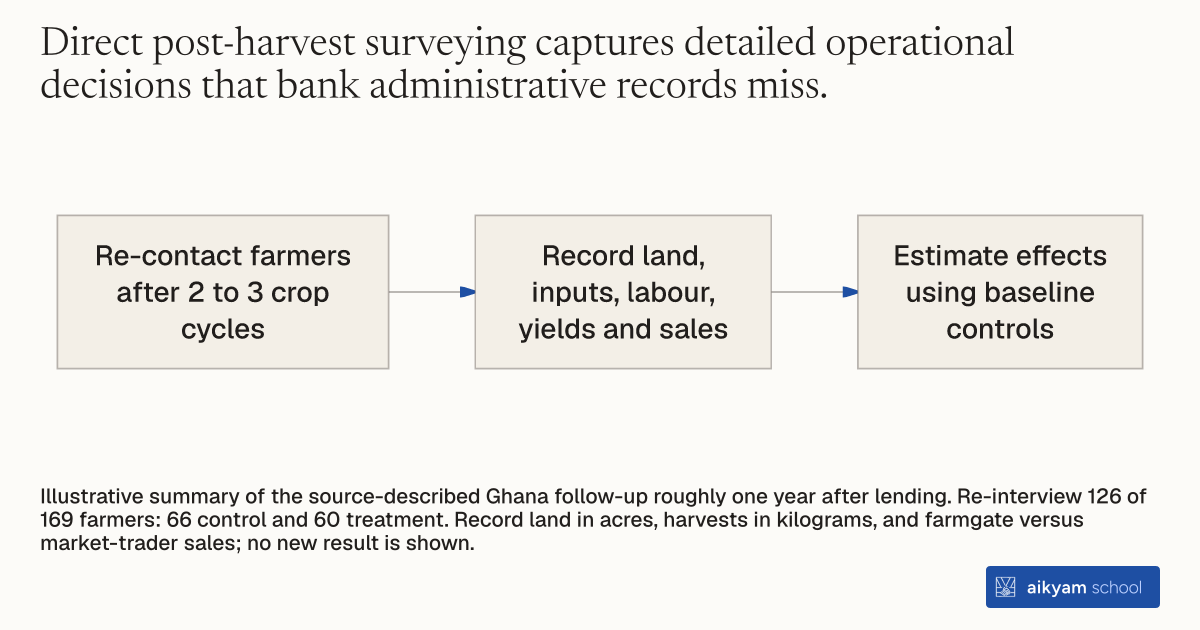
Research steps
Survey farm choices after harvest
- Re-contact farmers after 2 to 3 crop cycles
- Record land, inputs, labour, yields and sales
- Estimate effects using baseline controls
Illustrative summary of the source-described Ghana follow-up roughly one year after lending. Re-interview 126 of 169 farmers: 66 control and 60 treatment. Record land in acres, harvests in kilograms, and farmgate versus market-trader sales; no new result is shown.
See source →How
When to use
This method applies when an agricultural development organization needs to measure how financial risk protection alters smallholder farm choices over time. It solves the challenge of evaluating real investment changes beyond initial loan application rates. The approach enables program evaluators to track shifts in production inputs, crop selection, harvested yields, and marketing channels.
Evaluate agricultural investment and crop marketing changes by conducting a structured post-harvest survey one year after credit disbursement.
- Enumerators re-contact loan recipients across targeted rural communities roughly one year (after 2-3 crop cycles) following loan disbursement.
- Surveyors measure total land cultivated in acres, separating staple crops from cash crops.
- Enumerators record spending on chemical inputs, certified seed adoption, and labor days used per crop.
- Field staff quantify total crop harvests in kilograms for all cultivated fields.
- Surveyors record crop marketing choices, distinguishing sales made at the farmgate from sales made directly to market traders.
Why it works
Tracking specific marketing channels and input spending reveals how farmers reallocate resources when financial downside risk is reduced.
Example
In rural Eastern Ghana, research staff interviewed 126 smallholder maize and garden egg farmers one year after loan disbursement, finding that price-indemnified borrowers increased chemical spending share by 23.1 percentage points and sales to market traders by 18.5 percentage points.
About the study
Participants
126 smallholder farmers (66 control, 60 treatment) re-interviewed out of 169 baseline participants across 5 villages in rural Eastern Ghana.
Study Design
Post-harvest follow-up survey administered after 2-3 crop cycles (roughly one year) to estimate intent-to-treat effects using probit and tobit regressions with baseline controls.
Results
Indemnified loan offers increased the share of chemical input spending on primary crops by 23.1 percentage points (p < 0.10), increased probability of garden egg cultivation by 17.5 percentage points (p < 0.05), and increased sales to market traders by 18.5 percentage points overall (p < 0.10) and 25.4 percentage points among active growers (p < 0.05).