Research procedure
Measure choices before cash is paid
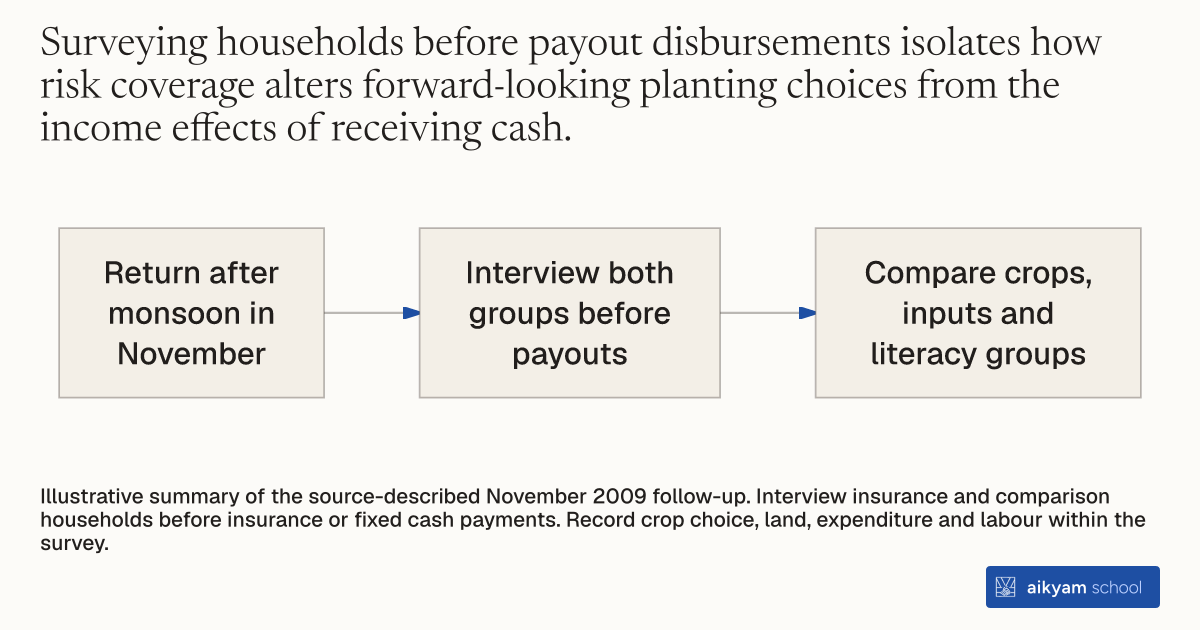
- Return after monsoon in November
- Interview both groups before payouts
- Compare crops, inputs and literacy groups
Illustrative summary of the source-described November 2009 follow-up. Interview insurance and comparison households before insurance or fixed cash payments. Record crop choice, land, expenditure and labour within the survey.
See source →How
When to use
Evaluating the behavioral effects of financial interventions on rural households requires measuring production decisions before payout disbursements confound expectations. Administer a post-monsoon follow-up survey to track land allocation, crop choice, and agricultural expenditures across smallholder farming households.
Conduct a systematic post-monsoon follow-up survey across smallholder farming households to measure agricultural investment and crop choice.
- Schedule household field surveys in November immediately following the June to November monsoon growing season.
- Interview household heads across both treatment and control groups prior to the disbursement of insurance payouts or fixed cash payments.
- Record household crop choices, focusing specifically on land allocated to cash crops like castor and groundnut versus subsistence crops.
- Survey total agricultural expenditures, input investments, and changes in labor usage for each cultivated plot.
- Disaggregate outcomes across household literacy levels and prior agricultural land allocation to assess heterogeneous treatment effects.
Why it works
Disaggregated survey modules reveal whether input constraints or educational gaps limit behavioral adoption.
Example
In November 2009, researchers surveyed 1,479 farming households in Andhra Pradesh, India, following the monsoon season. The survey measured crop selection and land allocation, revealing that insurance provision increased cash crop planting likelihood by 6 percentage points and increased cash crop land by 0.5 acres.
About the study
Participants
1,479 small farming households across 45 villages in Andhra Pradesh, India; average household size 5.35 members, household head average age 49.6 years (91% male, 54% with no formal schooling).
Study Design
Post-monsoon follow-up household survey conducted in November 2009 after the June-November production season, implemented before insurance payouts were disbursed to measure risk-taking and investment decisions.
Results
The follow-up survey revealed a 6 percentage point (12 percent) increase in the likelihood of planting cash crops from a 45 percent baseline, a 0.5 acre (27 percent) increase in cash crop land area from a 2-acre baseline, zero increase in overall agricultural expenditures, and a 15 percentage point cash crop increase among literate farmers compared to zero effect among illiterate farmers.