Try, learn and adjust
Check business training follows vocational instruction
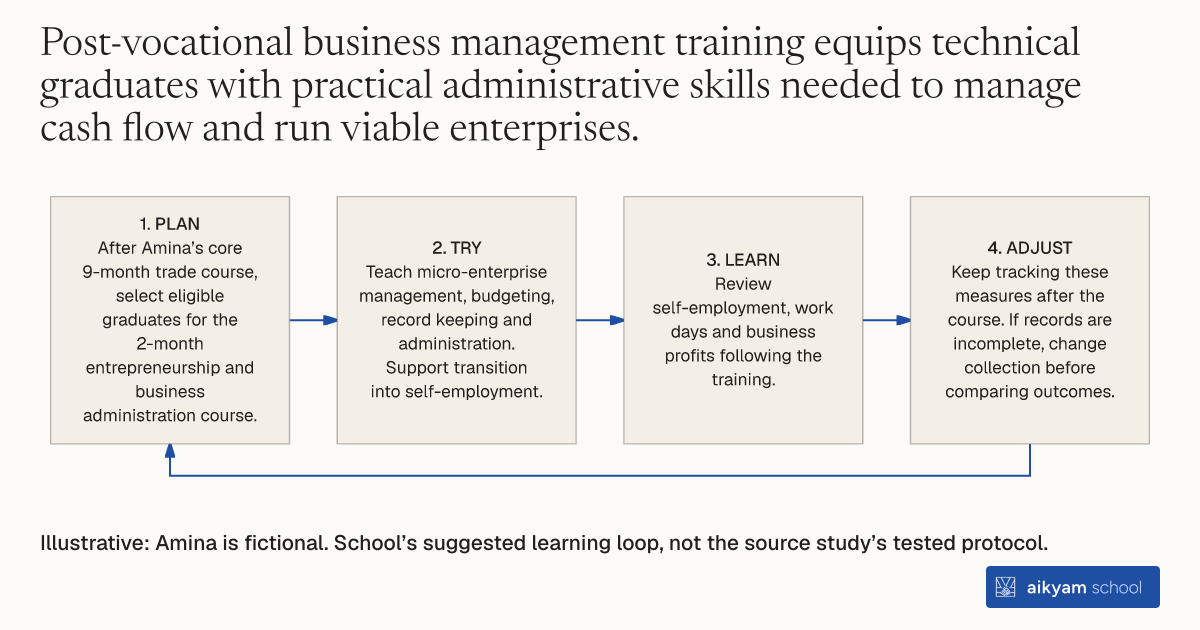
- Plan: After Amina’s core 9-month trade course, select eligible graduates for the 2-month entrepreneurship and business administration course.
- Try: Teach micro-enterprise management, budgeting, record keeping and administration. Support transition into self-employment.
- Learn: Review self-employment, work days and business profits following the training.
- Adjust: Keep tracking these measures after the course. If records are incomplete, change collection before comparing outcomes.
Illustrative: Amina is fictional. School’s suggested learning loop, not the source study’s tested protocol.
See source →School’s suggested learning loop: observe self-employment and profits; do not attribute the wider programme’s gains to the add-on course alone.
How
When to use
Many vocational trainees struggle to transition into self-employment without knowledge of micro-enterprise management and administration. Technical skill alone does not prepare low-income youth to start, cost, or manage small businesses. Providing supplemental entrepreneurship and business administration training after technical instruction helps graduates establish and sustain independent commercial activities.
Deliver targeted post-vocational business management training to vocational graduates to facilitate self-employment and micro-enterprise operation.
- Complete the core 9-month workshop-based technical trade training across community skills centers.
- Select eligible vocational graduates for supplemental post-vocational instruction.
- Enroll selected trainees into a 2-month post-vocational entrepreneurship and business administration course.
- Instruct participants in basic micro-enterprise management, budgeting, record-keeping, and business administrative practices.
- Support graduates as they transition into self-employment and small business operations within local markets.
Why it works
Combining technical skills with business knowledge enables trainees to monetize their trade competencies effectively through self-employment.
Example
Under the Mafita project in Northern Nigeria, program administrators offered 352 vocational trainees in the treatment group an additional 2-month entrepreneurship and business administration training following their 9-month trade training. Across the sample, self-employed work in the past month increased by 13.7 percentage points, days of self-employed work increased by 1.94 days, and monthly business profits rose by 997.11 Nigerian naira compared to control group means.
About the study
Participants
352 assigned vocational trainees offered entrepreneurship training within the 1,824 total study participants across Kaduna and Katsina states, Northern Nigeria.
Study Design
Regression analysis comparing outcomes across treatment and control groups with and without the entrepreneurship add-on component to verify core vocational impact.
Results
Self-employment increased by 13.7 percentage points (from a control mean of 38 percent), days of self-employment rose by 1.94 days (from 6.19 days), and monthly business profits increased by 997.11 naira (a 38.7 percent increase over the control mean of 2,573.58 naira).