Research steps
Measure walking before contracts
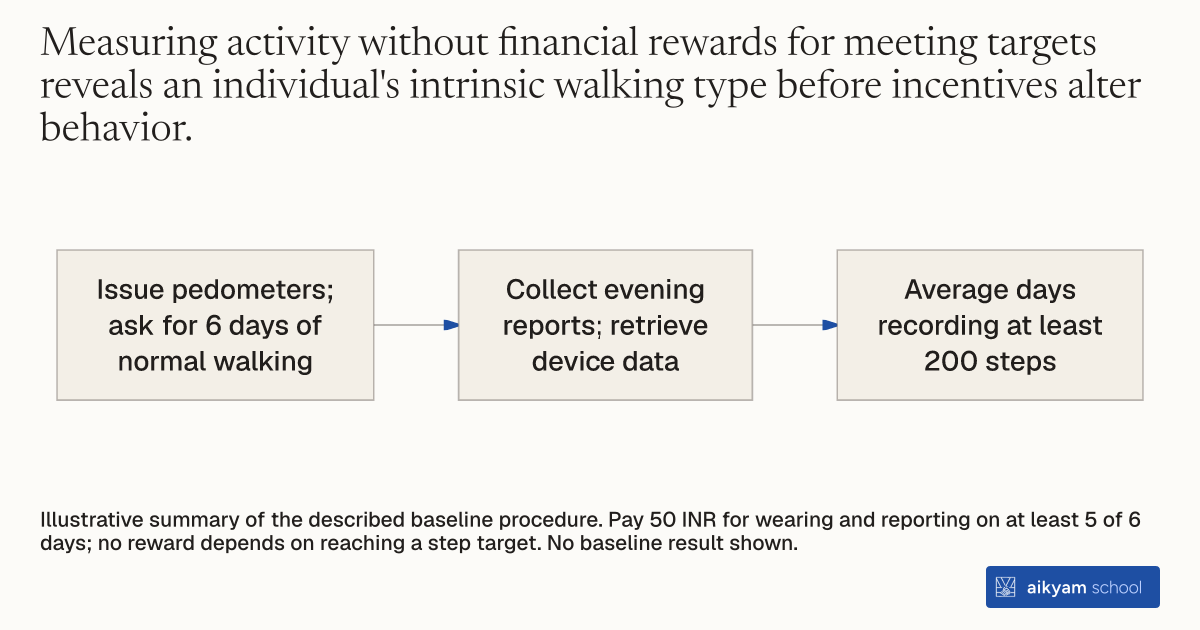
- Issue pedometers; ask for 6 days of normal walking
- Collect evening reports; retrieve device data
- Average days recording at least 200 steps
Illustrative summary of the described baseline procedure. Pay 50 INR for wearing and reporting on at least 5 of 6 days; no reward depends on reaching a step target. No baseline result shown.
See source →How
When to use
In incentive programs aimed at encouraging physical activity, participants vary widely in their unrewarded baseline behavior. Designing tailored targets or assessing self-selection requires measuring participants' default activity levels without financial distortions. Distributing pedometers during an initial unincentivized pre-contract period captures true baseline walking behavior.
Measure participants' unrewarded default walking activity using pedometers over an initial pre-contract period before introducing incentive contracts.
- Provide each participant with a pedometer at the initial household baseline survey visit and instruct them to walk as normal.
- Instruct participants to wear the pedometer daily for six days without financial rewards for meeting step targets.
- Offer a flat incentive of 50 INR for wearing the pedometer and reporting step counts for at least five of the six days.
- Have participants report daily step counts every evening through an automated calling system.
- Retrieve pedometer data during a second household visit and calculate baseline walking as the individual average of daily steps on days with at least 200 steps.
Why it works
Flat participation payments ensure high compliance and pedometer wearing without distorting daily step effort.
Example
In Coimbatore, Tamil Nadu, India, surveyors distributed pedometers to adults with diabetes or hypertension and measured baseline steps across a six-day pre-contract period, finding that participants walked an average of 7,230 steps per day without target incentives.
About the study
Participants
6,882 enrolled participants aged 30 to 65 (mean age 49, 37% female, 31% diabetic, 32% hypertensive) in urban Coimbatore, Tamil Nadu, India.
Study Design
Pre-contract observational phase within an RCT where participants wore pedometers for 6 days and received 50 INR for reporting steps on at least 5 days without step target incentives.
Results
Participants walked an average of 7,230 steps per day during the pre-contract period, establishing baseline walking types across 6,882 participants.