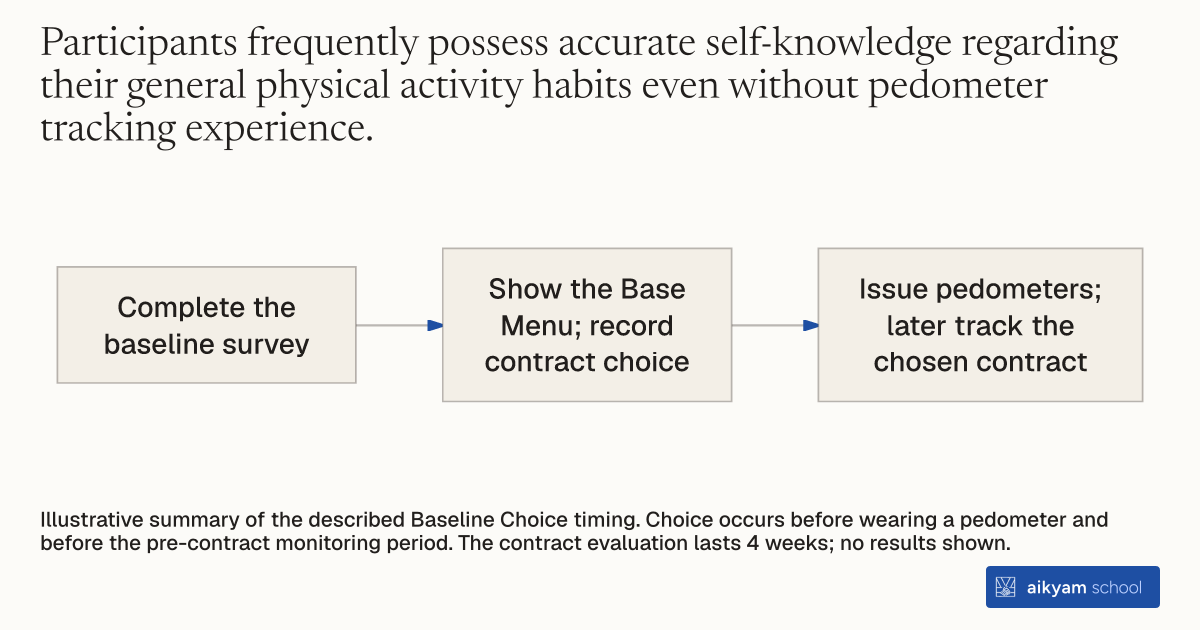
Research steps
Choose before pedometer experience
- Complete the baseline survey
- Show the Base Menu; record contract choice
- Issue pedometers; later track the chosen contract
Illustrative summary of the described Baseline Choice timing. Choice occurs before wearing a pedometer and before the pre-contract monitoring period. The contract evaluation lasts 4 weeks; no results shown.
See source →How
When to use
In physical activity incentive programs, administering an initial monitoring period with tracking devices before eliciting contract choices increases program timeline and administrative cost. Policymakers need to test whether participants require hands-on experience with tracking devices to choose appropriate incentive targets. Collecting contract choices prior to pedometer experience evaluates whether unexperienced participants make effective self-selection choices.
Gather incentive contract choices at program enrollment before participants gain hands-on monitoring experience with tracking devices.
- Administer the initial baseline health and demographic survey during a household visit.
- Present visual choice aids depicting the incentive menu options before issuing tracking devices.
- Require participants to choose their preferred daily step target contract from the menu.
- Issue digital pedometers to participants immediately after contract selection and launch the exercise period.
- Track daily step counts and deliver weekly target compliance incentives based on pre-experience contract selections.
Why it works
Eliciting contract choices prior to tracking experience simplifies program administration without sacrificing contract sorting or exercise performance.
Example
In Coimbatore, Tamil Nadu, India, researchers assigned 719 adults with diabetes or hypertension to choose step targets from the Base Menu at the baseline survey before wearing pedometers, resulting in an average daily step count of 6,961 steps (statistically indistinguishable from the 7,087 daily steps walked by participants choosing after 6 days of pedometer experience).
About the study
Participants
719 participants assigned to the Baseline Choice group out of 6,882 total enrolled adults aged 30 to 65 (mean age 50, 35% female, 31% diabetic, 32% hypertensive) in urban Coimbatore, Tamil Nadu, India.
Study Design
Randomized controlled trial evaluation arm where participants selected contracts from the Base Menu at the end of the initial baseline survey before the pre-contract pedometer period, compared against post-experience choice groups over a 4-week contract period.
Results
Eliciting choices prior to pedometer experience yielded daily walking of 6,961 steps (342 steps above Fixed Medium) with 0.39 INR higher daily payments, showing no statistically significant difference in choices, sorting, or daily steps relative to participants choosing after 6 days (7,087 steps, p-value 0.724).