Research design
Map baseline walking to a recommendation
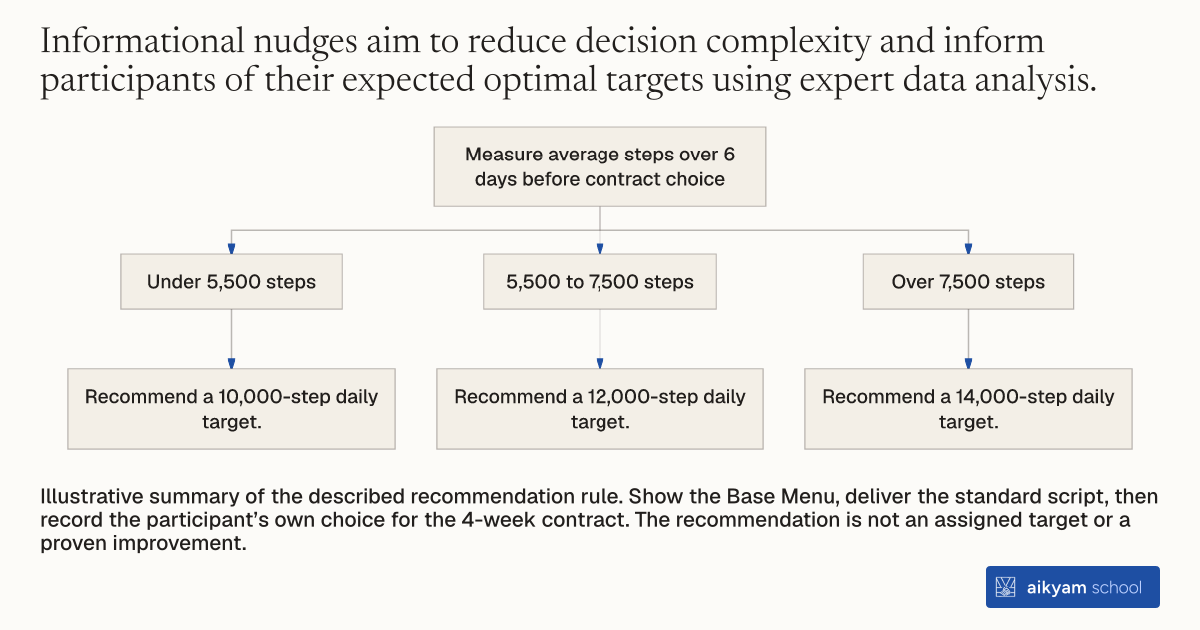
Measure average steps over 6 days before contract choice
- Under 5,500 steps
- Recommend a 10,000-step daily target.
- 5,500 to 7,500 steps
- Recommend a 12,000-step daily target.
- Over 7,500 steps
- Recommend a 14,000-step daily target.
Illustrative summary of the described recommendation rule. Show the Base Menu, deliver the standard script, then record the participant’s own choice for the 4-week contract. The recommendation is not an assigned target or a proven improvement.
See source →How
When to use
When individuals choose health behavior targets from incentive menus, policymakers may worry that participants lack information on which target maximizes their performance. Providing an expert recommendation or informational nudge aims to guide participants toward their optimal contract target based on baseline activity data. Testing this recommendation assesses whether expert advice improves participant sorting or if informational nudges inadvertently trigger resistance or backfiring among high baseline performers.
Guide participant contract selection on an incentive menu by providing an expert recommendation mapped from baseline activity levels before target selection.
- Measure each participant's baseline walking average over a six-day monitoring period.
- Map baseline steps to a recommended target tier: 10,000 steps for under 5,500 baseline steps, 12,000 steps for 5,500 to 7,500 steps, and 14,000 steps for over 7,500 steps.
- Present visual choice aids showing the Base Menu options during household visits.
- Deliver a standardized verbal script informing the participant which contract target researchers think will maximize their walking based on their baseline data.
- Record the participant's chosen contract after receiving the recommendation script and launch the four-week contract period.
Why it works
However, recommendations can backfire if participants possess private information about their personal effort costs or react against perceived pressure.
Example
In Coimbatore, Tamil Nadu, India, researchers provided 540 adults with diabetes or hypertension an expert recommendation script prior to contract choice, finding that the nudge reduced likelihood of choosing the recommended target among participants walking over 10,500 baseline steps.
About the study
Participants
540 participants assigned to Choice + Nudge out of 6,882 enrolled adults aged 30 to 65 (mean age 50, 40% female, 31% diabetic, 32% hypertensive) in urban Coimbatore, Tamil Nadu, India.
Study Design
Randomized controlled trial evaluation arm where participants received an expert recommendation mapping baseline steps (<5,500 to 10K, 5,500–7,500 to 12K, >7,500 to 14K) prior to selecting contracts on the Base Menu, compared against un-nudged Choice participants over a 4-week period.
Results
The Choice + Nudge group walked 82 steps more per day than Fixed Medium (compared to 420 steps for un-nudged Choice) and reduced choices of the recommended target by 15.7 percentage points among participants with baseline steps above 10,500.