Research groups
Separate applicants by prior arrest history
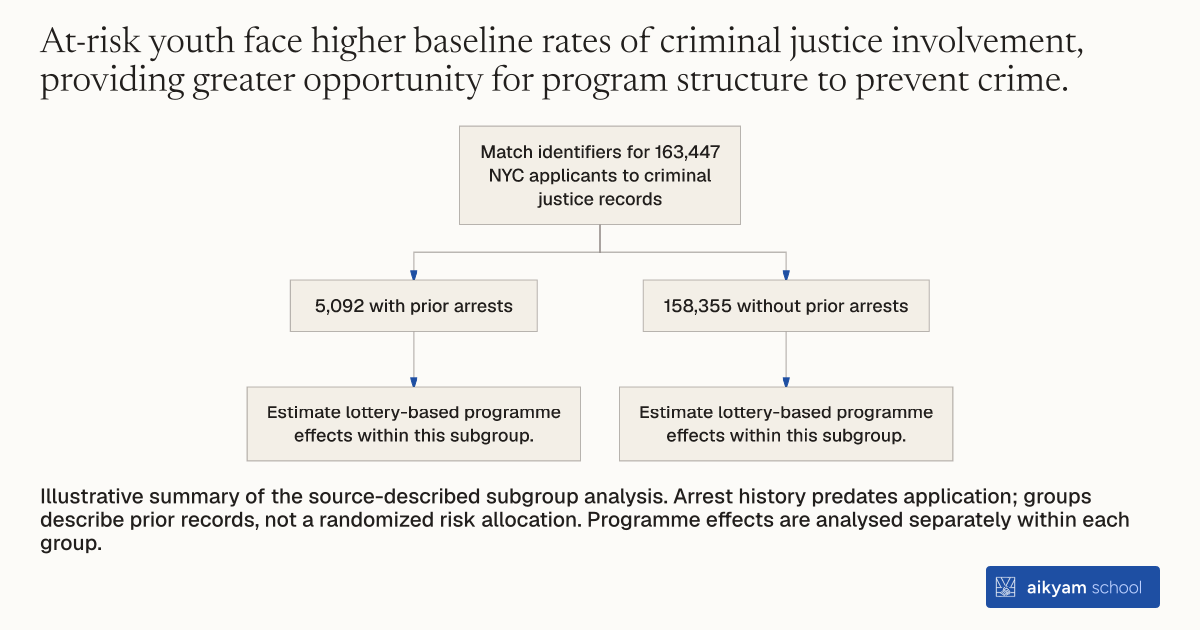
Match identifiers for 163,447 NYC applicants to criminal justice records
- 5,092 with prior arrests
- Estimate lottery-based programme effects within this subgroup.
- 158,355 without prior arrests
- Estimate lottery-based programme effects within this subgroup.
Illustrative summary of the source-described subgroup analysis. Arrest history predates application; groups describe prior records, not a randomized risk allocation. Programme effects are analysed separately within each group.
See source →How
When to use
Social interventions often show weak average effects across general populations. Screening administrative arrest records identifies high-risk subgroups where interventions achieve greater impacts. This method serves program managers targeting youth employment opportunities.
Screen applicant records against law enforcement databases to identify at-risk subgroups for targeted social programming.
- Program administrators collect full names, dates of birth, and Social Security numbers from youth applicants.
- Evaluators match applicant identifiers with state criminal justice administrative records.
- Analysts flag individuals who had an arrest prior to the program application date.
- Program planners separate applicants into at-risk youth with prior arrest histories and low-risk youth with no prior criminal contact.
- Evaluators analyze intervention impacts separately across both groups to measure subgroup effectiveness.
Why it works
Categorizing applicants by prior risk reveals large behavioral changes that remain hidden in overall population averages.
Example
Researchers screened 163,447 New York City youth applicants aged 16 to 21 against state criminal justice records from 2005 to 2008. Screening identified 5,092 at-risk youth with prior arrests and 158,355 low-risk youth without prior criminal contact. While low-risk youth showed no change in arrests, at-risk youth experienced a 2.75 percentage point reduction in summer arrests (a 23 percent drop) and a 2.09 percentage point reduction in convictions (a 52 percent drop).
About the study
Participants
163,447 youth applicants (5,092 at-risk youth with prior arrests and 158,355 low-risk youth), New York City.
Study Design
Subgroup-stratified two-stage least squares instrumental variable estimation comparing randomized lottery winners and losers linked to administrative arrest records.
Results
SYEP participation reduced summer arrests by 2.75 percentage points (23 percent) and convictions by 2.09 percentage points (52 percent) among at-risk youth. Low-risk youth showed a precisely estimated zero impact on summer arrests (0.046 percentage point reduction, statistically insignificant).