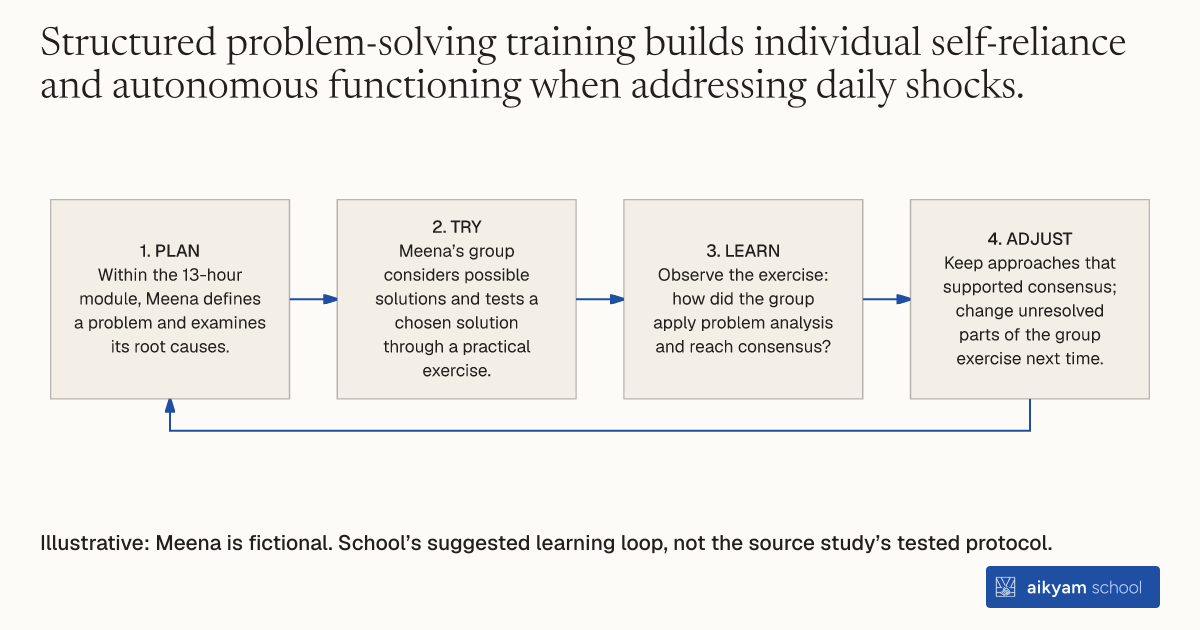
Try, learn and adjust
Check problem analysis in group exercises
- Plan: Within the 13-hour module, Meena defines a problem and examines its root causes.
- Try: Meena’s group considers possible solutions and tests a chosen solution through a practical exercise.
- Learn: Observe the exercise: how did the group apply problem analysis and reach consensus?
- Adjust: Keep approaches that supported consensus; change unresolved parts of the group exercise next time.
Illustrative: Meena is fictional. School’s suggested learning loop, not the source study’s tested protocol.
See source →School’s suggested learning loop, not a tested protocol. Observe problem statements, root-cause analysis and group decisions, not a separate module effect.
How
When to use
Frontline factory workers often lack structured techniques to analyze daily assembly line disruptions and navigate peer conflicts. Unresolved operational bottlenecks and poor group communication reduce overall team efficiency. Deliver a thirteen-hour problem-solving and decision-making module to frontline workers to build structured analytical habits and collaborative consensus.
Deliver thirteen hours of structured problem-solving instruction through interactive group discussions, role plays, and practical application modules over multiple classroom sessions.
- Conduct introductory group discussions and role plays exploring different problem-solving approaches, such as individual self-reliance versus seeking help from peers.
- Teach participants to define a clear problem statement for an active workplace or personal issue.
- Guide participants to analyze the root causes underlying the identified problem statement.
- Lead brainstorming exercises where workers generate and evaluate all possible solutions to the root cause.
- Direct small teams to execute learning-by-doing group exercises that test chosen solutions.
- Facilitate application modules demonstrating consensus-building and decision-making dynamics in the factory, at home, and in the community.
Why it works
Group consensus-building enables workers to resolve operational bottlenecks collaboratively without relying on constant supervisory intervention.
Example
A garment export business delivered the 13-hour Problem Solving and Decision-Making module to 1,087 female workers across 5 factories in Bengaluru, India. Participants practiced root-cause analysis and group decision-making exercises, which contributed to an 85 to 110 percent increase in post-module test scores and a 20 percent relative increase in post-program workplace efficiency.
About the study
Participants
2,703 female garment workers across 112 production lines in 5 export factories in Bengaluru, India.
Study Design
Two-stage randomized controlled trial evaluating pre- and post-module assessment scores and daily worker production efficiency via tablet computers following a 13-hour problem-solving module.
Results
Treated workers substantially improved problem-solving test scores between pre- and post-module assessments, contributing to an overall post-program efficiency gain of 10.8 percentage points (p < 0.05) and a 0.20 standard deviation increase in autonomous functioning (p < 0.05).