Try, learn and adjust
Check the investment plan before grant delivery
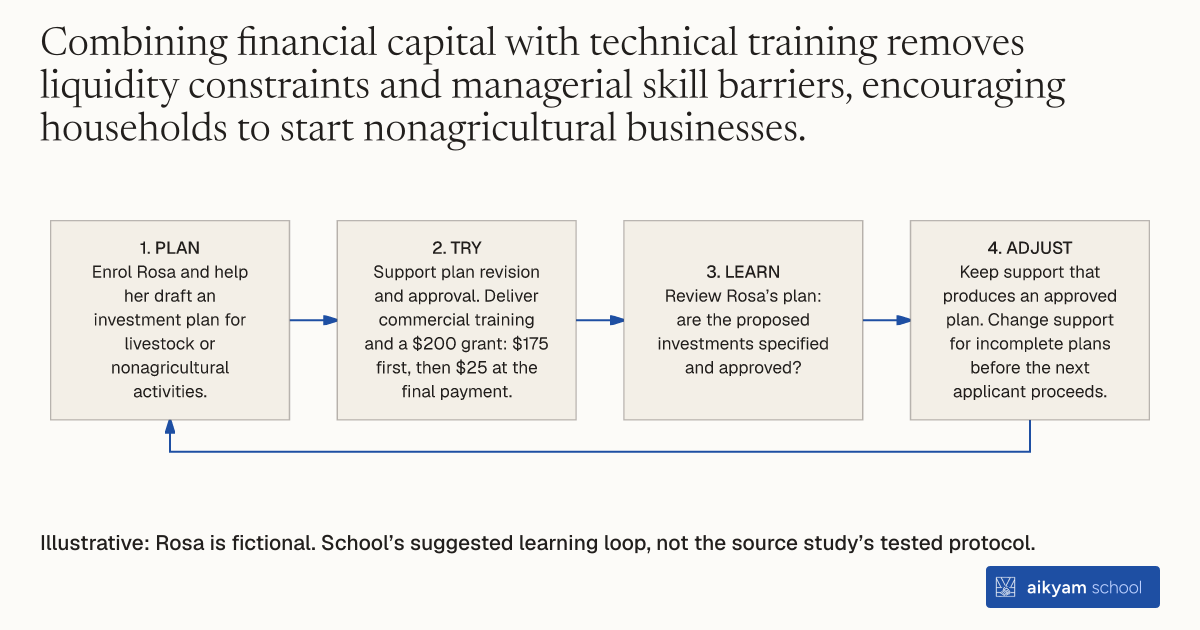
- Plan: Enrol Rosa and help her draft an investment plan for livestock or nonagricultural activities.
- Try: Support plan revision and approval. Deliver commercial training and a $200 grant: $175 first, then $25 at the final payment.
- Learn: Review Rosa’s plan: are the proposed investments specified and approved?
- Adjust: Keep support that produces an approved plan. Change support for incomplete plans before the next applicant proceeds.
Illustrative: Rosa is fictional. School’s suggested learning loop, not the source study’s tested protocol.
See source →School’s suggested, untested loop. Observe plan approval and grant instalments; this is not evidence of business income effects.
How
When to use
Poor rural households facing agricultural shocks like drought need to create assets and diversify income beyond subsistence farming. Basic cash assistance protects consumption in the short term, but long-term upward mobility requires expanding nonagricultural self-employment. Providing grants paired with business training and technical assistance enables beneficiaries, particularly women, to launch small commercial ventures.
Provide conditional capital grants, commercial skill training, and technical assistance to female household heads to establish nonagricultural micro-enterprises.
- Enroll primary female caregivers from targeted poor households into the productive investment program.
- Require each recipient to draft a business development plan specifying investments in new livestock or nonagricultural income activities.
- Provide technical assistance to help beneficiaries draft, submit, and revise their business plans for approval.
- Deliver training in basic commercial skills and asset management to participating female caregivers.
- Disburse a 200 US dollar capital grant in two installments—175 US dollars up front and 25 US dollars at the final payment date—for approved investments.
Why it works
Empowering female caregivers with new economic opportunities increases income diversification and shifts household labor specialization.
Example
In rural northwest Nicaragua, 1,000 eligible poor households received the productive investment package as part of the Atención a Crisis pilot program. Female recipients drafted business plans with project staff support, completed commercial training, and received 175 US dollars to launch small commercial or livestock enterprises.
About the study
Participants
1,000 poor households in 56 intervention communities in rural northwest Nicaragua with average annual per capita expenditure of 250 US dollars.
Study Design
Randomized controlled trial comparing households receiving basic conditional cash transfers plus productive investment grants against basic CCT recipients and control communities.
Results
Take-up of the productive investment grant was near 100 percent, leading to higher nonagricultural self-employment income, an increase in agricultural wage labor hiring by 20 percent, and a shift of older girls toward nonagricultural and domestic labor without increasing their total work hours.