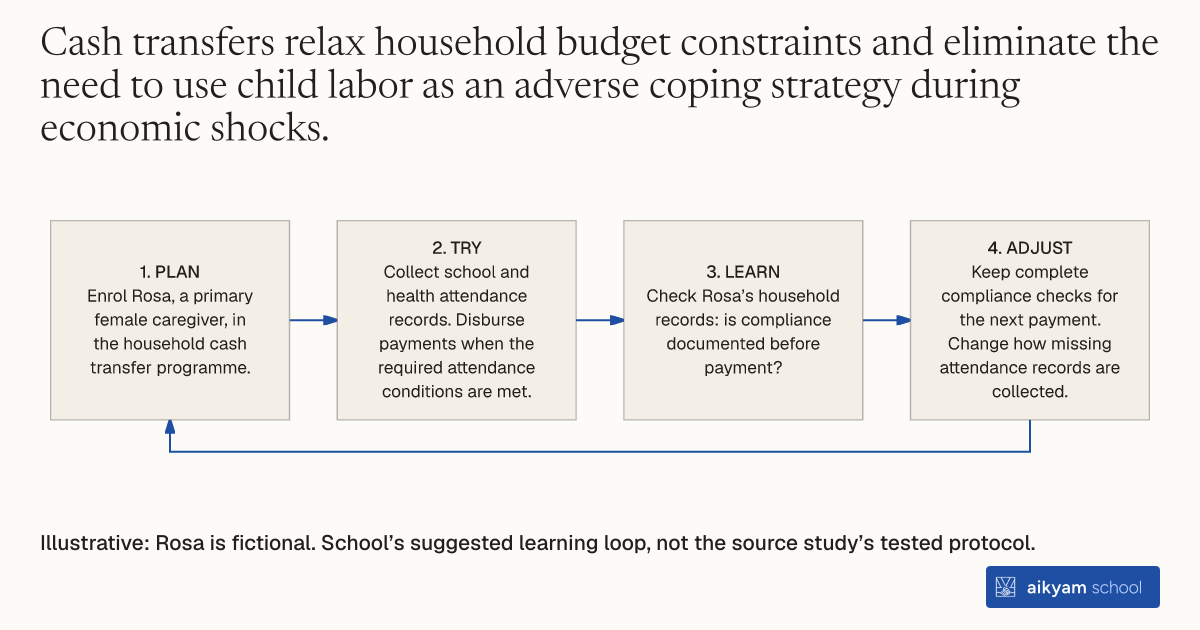
Try, learn and adjust
Check attendance conditions before cash delivery
- Plan: Enrol Rosa, a primary female caregiver, in the household cash transfer programme.
- Try: Collect school and health attendance records. Disburse payments when the required attendance conditions are met.
- Learn: Check Rosa’s household records: is compliance documented before payment?
- Adjust: Keep complete compliance checks for the next payment. Change how missing attendance records are collected.
Illustrative: Rosa is fictional. School’s suggested learning loop, not the source study’s tested protocol.
See source →School’s suggested, untested loop. Observe attendance records, compliance checks and payments; this does not establish changes in child labour.
How
When to use
Poor rural households in developing regions affected by drought shocks often pull children out of school to perform agricultural or domestic labor. Providing cash transfers conditioned on primary school attendance and health checkups helps families overcome income shortfalls while keeping children enrolled in school. This method protects human capital accumulation and reduces child labor among vulnerable children.
Distribute bi-monthly cash transfers to primary female caregivers on condition that primary-school-age children regularly attend school and health services.
- Identify eligible impoverished households with children aged 7 to 15 who have not completed primary school.
- Enroll the primary female caregiver of each eligible household as the direct cash recipient.
- Pay a bi-monthly base cash transfer of 235 US dollars per household plus an additional 25 US dollars for each child subject to school attendance conditionalities over a one-year program period.
- Collect attendance records directly from primary school teachers and health service providers to monitor compliance.
- Disburse cash payments to female caregivers who meet the required attendance thresholds.
Why it works
Enforcing school attendance guarantees that children are in class during morning hours when agricultural work typically occurs, directly substituting schooling for child labor.
Example
In rural northwest Nicaragua, the Ministry of the Family implemented the Atención a Crisis pilot program between November 2005 and December 2006. Households received a base transfer of 235 US dollars plus 25 US dollars per conditioned child, representing 15 to 20 percent of average household expenditures, with compliance monitored through primary school teachers.
About the study
Participants
4,400 households surveyed across 106 communities in 6 rural municipalities in northwest Nicaragua, where average annual per capita expenditure was around 250 US dollars.
Study Design
Randomized controlled trial comparing 56 intervention communities with 50 control communities using household fixed effects to analyze intra-household child labor reallocation among siblings.
Results
The basic cash transfer reduced total child labor by 1.5 hours per week more for older boys than for girls, primarily by cutting agricultural work, and reduced child labor in economic activities by 3 hours per week for boys at least 1 grade behind in school.