Research steps
Survey providers at their garages
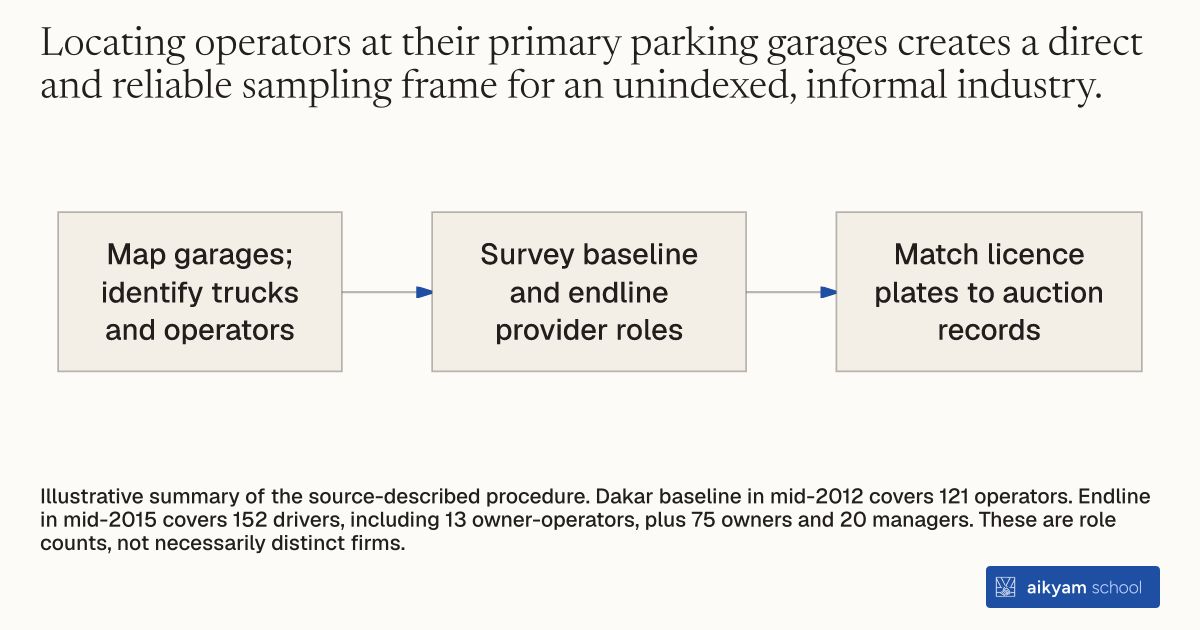
- Map garages; identify trucks and operators
- Survey baseline and endline provider roles
- Match licence plates to auction records
Illustrative summary of the source-described procedure. Dakar baseline in mid-2012 covers 121 operators. Endline in mid-2015 covers 152 drivers, including 13 owner-operators, plus 75 owners and 20 managers. These are role counts, not necessarily distinct firms.
See source →How
When to use
Researchers or evaluators need to map supply-side market structure, fleet characteristics, and operator conduct in a fragmented informal service sector. The method addresses missing sampling frames where service providers park in decentralized garages rather than registering with central administrative rosters. It is designed for study teams evaluating market power, capacity constraints, and operator participation in urban utility or sanitation programs.
Conduct a comprehensive census of decentralized service providers by visiting active parking locations and surveying fleet managers, truck owners, and drivers.
- Survey enumerators map all major and informal garages where vacuum truck operators park across the metropolitan area.
- Enumerators visit each garage to identify active trucks, fleet managers, and individual drivers associated with specific license plates.
- Enumerators administer baseline surveys to track baseline fleet attributes, primary garage affiliations, and operator characteristics.
- Enumerators re-survey operators at endline to record changes in fleet ownership, driver roles, manager oversight, and platform participation.
- Survey supervisors verify truck license plates to cross-reference administrative auction records with garage-based provider data.
Why it works
Surveying drivers, owners, and managers separately distinguishes operational capacity, wage structures, and revenue-sharing arrangements across different levels of firm decision-making.
Example
Researchers in Dakar, Senegal conducted a census of desludging truck operators across city garages. They interviewed 121 truck operators at baseline in mid-2012 and 152 drivers (including 13 owner-operators), 75 truck owners, and 20 managers at endline in mid-2015 to measure garage affiliations, fleet sizes, and excess capacity.
About the study
Participants
121 desludging truck operators surveyed at baseline in mid-2012, and 152 drivers (13 owner-operators), 75 truck owners, and 20 managers surveyed at endline in mid-2015 across garages in Dakar, Senegal.
Study Design
Two-wave baseline and endline provider census survey tracking active trucks, driver affiliations, fleet managers, garage locations, and operational characteristics across Dakar.
Results
The census surveyed 152 drivers, 75 truck owners, and 20 managers across 126 registered platform trucks, finding that drivers perform an average of slightly more than 1 trip per day with 85% reporting excess capacity, while 50% of trucks belong to companies affiliated with the AAAS trade association.